Showing posts with label gender difference. Show all posts

Friday, 1 June 2007

Ringing the chicks - disruption likely

Ringing a chick from the 2006 brood

Please note that we will be ringing the two chicks this evening (June 1st). There will be some disruption to the web cam pictures for about an hour while the ringing is in progress. We will disable the cameras, otherwise viewers will see parts of the abseiler suddenly appearing on the platform and will probably start to panic, thinking there was an intruder!


The female will certainly fly about screaming at us. However, only minutes after the chicks have been replaced on the platform, she will return to brood them and life will return to normal.


The licenced ringers, are very experienced at this work. They have been ringing peregrines and other raptors for many years and what they will do tonight is quite routine for them.


More details about the chicks, what sex they are and the details of their rings will follow later.


Note that the photo shows one of LAST year's chicks being ringed.

Thursday, 3 May 2007

The Calm Before The Storm

Female peregrine incubating her four eggs. Click to enlarge picture. It's a deceptively quiet time now.

We're now settling in to a routine of around 500 new visitors, plus another 500 returning visitors to our webcams every day. We welcome you all, and thank you for heeding the call to close your browsers after watching. It's done the trick, and drastically lightened the load on the Streamdays servers.

The Derby Cathedral peregrines have now settled into an incubation routine, too. It's clear that the female sits on the eggs for most of the night, getting relieved either an hour or two before dawn, or shortly afterwards. There are usually a couple of changeovers during the day before she resumes again for the night shift. Only once so far has the male spent most of the night on the eggs.
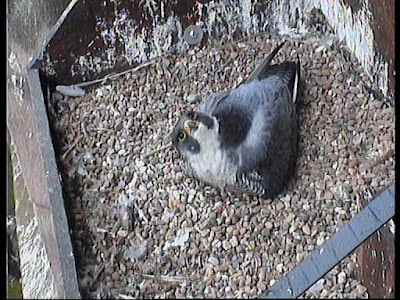

Male peregrine incubating four eggs. Note his smaller size, darker tone, and tiny dot on the side of his face. Click to enlarge picture.These changeovers nornally takes less than a minute, but once or twice the eggs have been left exposed for six or seven minutes.

Sometimes the sitting bird simply doesn't want to move. More than once the larger female has seemed to stand bemused by her failure to rouse her partner, or vice versa. But she's bigger, and when she waddles slowly in from the right side of the platform he invariably gets up and flies off. If you see a changeover online you're quite lucky. Had we managed to get our audio channel up and running in time this would have been a useful early-warning of a changeover, as the birds call to each other with a gentle chirrupping or ee-chupping sound when one of them arrives on the ledge.

So how do you tell which is the male and which is the female?
The answer is it's not always easy when there's only one bird there. But look firstly for size. The female (top picture) is considerably bulkier than the male (lower picture). Because of her bulk, her wing tips usually stick upwards much more than those of the male. She is a lighter grey tone than him. If you look at the male in the lower picture, you'll see he is smaller and slightly neater in size, with a darker tone to his head and back. Note, too, the tiny white dot on his right moustache-like stripe on his head. The female doesn't have this, and it's visible too through a telescope from Cathedral Green. When they are side by side, there's no problem. She is so much bigger then he is, and he acts quite submissively to her.

We've pulled back on the zoom a little bit as the night-time focussing wasn't very sharp when the camera was really close up. At night it's nearly always the bulkier female who incubates the eggs. hatching won't be too far away, and our next blog entry will give you some clues to watch out for when it becomes imminent.
Behind the scenes it's anything but a quiet time. The DWT are busy gathering volunteers together to organise various Watch events on Cathedral Green, whilst the Museum is in talks with Streamdays about a possible full-speed streaming video service.. We've had a BBC wildlife photographer down to film at The Sanctuary and at Derby Cathedral this week for a new series on the Nature of Britain with Alan Titchmarsh. We're working on ways to remotely focus and zoom the peregrine camera in time for hatching, and we're trying to get an audio stream and a still image archive set up. That, plus the rest of our duties, it's far from a quiet time. Someone once asked whether we did this for the money. Most certainly not; it's for the love of the work that we do.

Meanwhile, enjoy watching.

Saturday, 24 March 2007

A Tasty Morsel

There were still no signs of egg-laying when the Cathedral cameras were checked on Friday. However, reviewing the previous three days of recording revealed lots of nest scraping and head bowing activities. Whenever mutual bowing occurs it's amazing to see how still the male can remain - sometimes up to ten minutes at a time. (See video clip for March 14th for an example of this activity) At other times he stares intently for some minutes at the female who is usually off-camera on the other side of the ledge. Here are more details of courtship behaviour in American peregrines, and it mirrors exactly what we're seeing in Derby. The only difference is that we are seeing a lot of food being brought to the nest platform for consumption. But as yet there's no evidence of copulation occurring on the platform, although mating was witnessed on one of the gargoyles at the top of Derby Cathedral's tower on Wednesday 21st March.)

On Thursday 22nd March we recorded the male bringing food to the nest and passing it to the much larger female. Watch this by clicking on the YouTube image below.

(Note the better quality recording; for some reason this clip could be processed directly by computer, rather than having to use a video camera pointing at a TV screen for previous clips!)

We'd like to build a questions and answers page about our peregrine falcons. If you'd like to send us any suggestions for things you'd like to see answered, please complete the "Contact Us" form at the bottom of the main peregrine page on Derby City Council's website.

At last there's progress with our internet connection! Next week Capita (the Council's external IT agents) will be arranging the dismantling and transfer of the radio equipment necessary to give us our internet connection. How long it then takes to configure us to the City council's servers is still anyone's guess, but our ICT Unit are now building the necessary page ready to receive the webcam images. Fingers crossed!

A meeting with Derby Cityscape on Friday afternoon was fruitful, and we should soon be able to reveal how much access we're likely to get on Cathedral Green during the summer. (You may be aware that the whole Green is to be landscaped later this year, and access to the site has been of great concern to many people)

Saturday, 3 March 2007

Aerial Action


Reports were received today of aerial display by the pair in the skies to the east of the tower and of the male bringing prey for the female which she then took down to the platform.
Arriving half an hour later with the telescope, a small group of passers-by soon gathered in the sunshine. The female was sitting on the platform edge looking out. She seemed huge, her breast feathers fluffed out. The male, looking tiny by comparison (and with a much yellower cere and darker head than the female) was in the tiny crevice directly above the platform, feeding.
Apparently one of last year's juveniles is still returning to the tower, usually in the late afternoon and perhaps is roosting there still.
Also, while the peregrines were away the other day, a crow was seen to steal a dead fieldfare which had been stashed in a lead gutter close to the gargoyles (as shown).