*Derby Peregrines – Nest Cam 1*
*Derby Peregrines – Nest Cam 2*

Peregrine Falcons first nested on Derby's Cathedral, England, in 2006. Our Peregrine Project is now run by a partnership between Derbyshire Wildlife Trust, Derby City Council, Derby Cathedral and the Cathedral Quarter. Here is what's happening in 2026. . .
Monday, 31 December 2007


Monday, 10 December 2007
Maintenance Work
The webcameras have recently been out of action, and may be again. Electrical safety checks inside Derby Cathedral over the last week or so have been severing our connection to the internet at frequent but irregular intervals. This work is essential to ensure the safety and integrity of Derby's most important (and oldest) building. Resuming the video stream each time involves a climb to the bell-ringing chamber to manually re-boot a PC and, in the run-up to the Christmas season, this is hardly something we can ask anyone to do for us at the "drop of a hat". We hope that we may be able to configure this item out of the circuit entirely for next season, making the video stream less susceptible to power failure. You will also see that our main camera has now "drooped" somewhat. This will be fixed on our next abseil.
 Meanwhile we will remove and rebuild the control unit which allows us to remotely focus and zoom one of our cameras. This was lashed-up for us last summer by John Salloway, who has kindly agreed to box it up to make it more rugged, too. To give you an idea of how close we can go, here's a picture captured during the summer of one of our ringed chicks. Click the image to enlarge.
 Meanwhile we will remove and rebuild the control unit which allows us to remotely focus and zoom one of our cameras. This was lashed-up for us last summer by John Salloway, who has kindly agreed to box it up to make it more rugged, too. To give you an idea of how close we can go, here's a picture captured during the summer of one of our ringed chicks. Click the image to enlarge.
Monday, 26 November 2007
Derby "De-Lights" Tonight
 The lights in Derby go out for an hour tonight between 9pm-10pm local time (Monday 26th), as part of a city-wide campaign to raise awareness of the impact we all make on global energy consumption and climate change emissions. Businesses and home users are all being urged to demonstrate the impact we can all make on the environment by switching off lights and other equipment. You can read more here.
You may therefore notice of one of three things with our webcams:
a) no change at all - everything works fine
b) the picture freezes as the power to the tower is cut for an hour
c) background street illumination is dimmed as all Christmas lights, cathedral floodlights and other lights are turned off (except street lighting, of course)
I hope readers will forgive us if we don't specially go in to turn off the webcamera power for this period; it would use more energy in petrol for us to drive in than it would save. But rest assured that this blog-writer's home will have all un-needed power consumption turned off. Nothing new there, then.
Meanwhile, do enjoy the image below of our male peregrine keeping up appearances on the nest scrape at the weekend. He was actively pushing back the gravel layer with his feet for quite some time. It's looking good for next season!


Friday, 23 November 2007
Questions and Answers
One of our regular viewers, Jennie in Hong Kong, recently posted some very pertinent questions in this blog's comments. We've put these and a few others we've received in bold, and have tried to answer them as best as we can.
Where would the birds be if the box were removed? - well, they would still be on the Cathedral, it's as simple as that. They chose the Cathedral as their favourite site in Derby, England, from which to hunt and on which to roost - just as other peregrines have probably done on and off here for hundreds of years.
Why do they return to the nest platform each day? Probably to assure themselves that it's still OK, and to reinforce their possession of it against any competition that might come through. We know that they have been undertaking occasional nest-scraping actions at least since mid-October, and in certain light the depression in the gravel on the left side of the platform is very clear to see. The picture on the left was taken on November 13th at 8.30GMT, just about 1.5hrs after dawn broke. The male on the right remained static, with head bowed, for about five minutes, and the female on the left didn't move much either. The picture below was taken on 18th November after the first snowfall of winter in Derby - the nest scrape is highlighted well under the infra-red light.

I didn't see them nest-scraping whenever I watched. Do the birds do this at a particular time, say in the morning or at night? Is this the job for the male or female?
I'm not sure there's a particular time that they do this. It's quite a rare event to see this time of year, and with the 15 second change of images it could easily be missed. You can see a video clip here As stated above, the most reliable time to see the birds is shortly after dawn, so try watching around 7am-8am local time. From our experience in 2007, we'd say that it's the adult male who does most of the nest-scraping.
Would the parents recognise the juveniles from this season if they returned? Well, based on the evidence we saw earlier in the year, we think they would. Visit our blog entries for March 21st and 6th April and you'll see two of our YouTube videos showing one of the previous year's chicks on the nest platform. Not only were the parents not bothered by their offspring's presence, at one point the adult male seemed quite intimidated by the young bird. I'm sure the juveniles were only tolerated because they were recognised as being the young of these particular birds. Elsewhere the young of other peregrines have been known to stay around and help feed the new season's chicks.
Now that the babes are ringed and fledged..have there been any sightings? And if so is there a place where they are logged and can be viewed?
The last known sighting of one of the peregrine chicks from 2007 was about 10 miles away, where a colour-ringed peregrine was seen in early October. It wasn't possible to tell if it was oo1 or 002. We will, of course bring you news of the juveniles as soon as we hear it. As far as I'm aware though, it's not currently possible to look up bird ringing results online - but I'll amend this if I'm proved wrong.
Nadine in Australia emailed us to say that the night-light on the left hand side is not working and hoped that we would get it fixed as our night time is her daytime, and is the only period when she can watch for the peregrines. The problem is partly due to the fact that this camera has sagged slightly over the last few months. It now points down and "sees" more of the floodlighting on the cathedral tower, and is fooled into thinking that it's still daytime, so it turns off the infra-red illumination. When we next abseil down we'll try and make all the necessary adjustments, but in the meantime we've remotely fiddled with the camera iris, and it seems to have done the trick. The night-time IR illuminator now works more often than not.
Why does the camera picture freeze up ocassionally? This is usually a problem with the video server inside Derby Cathedral, or our link to Streamdays. Once we're aware of a problem we can normally re-boot our equipment remotely, but sometimes we have to climb the spiral staircase and start the equipment manually. A break in signal in mid-November was caused by the accidental disconection of the pwoer supply to some receiving equipment inside The Silk Mill Museum, through which our signals pass. Thanks to the guys from Capita IT Services for remedying that one.
Where would the birds be if the box were removed? - well, they would still be on the Cathedral, it's as simple as that. They chose the Cathedral as their favourite site in Derby, England, from which to hunt and on which to roost - just as other peregrines have probably done on and off here for hundreds of years.
Why do they return to the nest platform each day? Probably to assure themselves that it's still OK, and to reinforce their possession of it against any competition that might
 come through. We know that they have been undertaking occasional nest-scraping actions at least since mid-October, and in certain light the depression in the gravel on the left side of the platform is very clear to see. The picture on the left was taken on November 13th at 8.30GMT, just about 1.5hrs after dawn broke. The male on the right remained static, with head bowed, for about five minutes, and the female on the left didn't move much either. The picture below was taken on 18th November after the first snowfall of winter in Derby - the nest scrape is highlighted well under the infra-red light.
I didn't see them nest-scraping whenever I watched. Do the birds do this at a particular time, say in the morning or at night? Is this the job for the male or female?
I'm not sure there's a particular time that they do this. It's quite a rare event to see this time of year, and with the 15 second change of images it could easily be missed. You can see a video clip here As stated above, the most reliable time to see the birds is shortly after dawn, so try watching around 7am-8am local time. From our experience in 2007, we'd say that it's the adult male who does most of the nest-scraping.
Would the parents recognise the juveniles from this season if they returned? Well, based on the evidence we saw earlier in the year, we think they would. Visit our blog entries for March 21st and 6th April and you'll see two of our YouTube videos showing one of the previous year's chicks on the nest platform. Not only were the parents not bothered by their offspring's presence, at one point the adult male seemed quite intimidated by the young bird. I'm sure the juveniles were only tolerated because they were recognised as being the young of these particular birds. Elsewhere the young of other peregrines have been known to stay around and help feed the new season's chicks.
Now that the babes are ringed and fledged..have there been any sightings? And if so is there a place where they are logged and can be viewed?
The last known sighting of one of the peregrine chicks from 2007 was about 10 miles away, where a colour-ringed peregrine was seen in early October. It wasn't possible to tell if it was oo1 or 002. We will, of course bring you news of the juveniles as soon as we hear it. As far as I'm aware though, it's not currently possible to look up bird ringing results online - but I'll amend this if I'm proved wrong.
Nadine in Australia emailed us to say that the night-light on the left hand side is not working and hoped that we would get it fixed as our night time is her daytime, and is the only period when she can watch for the peregrines. The problem is partly due to the fact that this camera has sagged slightly over the last few months. It now points down and "sees" more of the floodlighting on the cathedral tower, and is fooled into thinking that it's still daytime, so it turns off the infra-red illumination. When we next abseil down we'll try and make all the necessary adjustments, but in the meantime we've remotely fiddled with the camera iris, and it seems to have done the trick. The night-time IR illuminator now works more often than not.
Why does the camera picture freeze up ocassionally? This is usually a problem with the video server inside Derby Cathedral, or our link to Streamdays. Once we're aware of a problem we can normally re-boot our equipment remotely, but sometimes we have to climb the spiral staircase and start the equipment manually. A break in signal in mid-November was caused by the accidental disconection of the pwoer supply to some receiving equipment inside The Silk Mill Museum, through which our signals pass. Thanks to the guys from Capita IT Services for remedying that one.
Friday, 2 November 2007
Admin message: Comment Spamming
From today we've added word verification for all comments left on this blog. This means you'll now be prompted to read some words and type them in to a box before your comments get posted.
I'm afraid we've been hit recently with a huge number of automated comments left on archived posts. These posting themselves look innocuous, but there is a risk that anyone clicking on the hyperlink of the persons name will be taken to inappropriate or virus-laden websites. We do our best to remove these postings when they appear. Please don't click on any links you may find.
I'm afraid we've been hit recently with a huge number of automated comments left on archived posts. These posting themselves look innocuous, but there is a risk that anyone clicking on the hyperlink of the persons name will be taken to inappropriate or virus-laden websites. We do our best to remove these postings when they appear. Please don't click on any links you may find.
Sunday, 28 October 2007
Windy Morning

This morning, a blustery SW wind was certainly almost blowing the flag on the tower top off its pole! Both peregrines were on the east side, sheltering. the male was tucked in by the lead gutter, the female, initially on the platform, had moved up to sit on the same ledge as the male but half way along when I returned to look at them with the telescope.
The photo shows a fieldfare in this lead gutter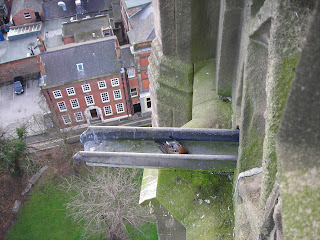 which the birds use as a 'fridge'. Fieldfares don't breed in the UK but come here from Scandinavia and East Europe in the winter. The lower photo shows a close up of the bird. The photos were taken last February on the day the cameras were fixed...there's been a lot of water under the bridge (or should that be fieldfares in the gutter?) since then of course!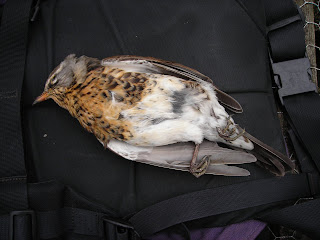
 which the birds use as a 'fridge'. Fieldfares don't breed in the UK but come here from Scandinavia and East Europe in the winter. The lower photo shows a close up of the bird. The photos were taken last February on the day the cameras were fixed...there's been a lot of water under the bridge (or should that be fieldfares in the gutter?) since then of course!
NickB
Thursday, 25 October 2007
Peregrines on UK TV - NEW POSTING
.JPG)
If you are UK based you may have seen BBC1 TV's The Nature of Britain programme last night on urban wildlife with great shots of peregrines in Bath. If you live in the East Midlands you will have seen the short sequence about 'our' Derby birds at the end, beamed just to the region. The programme is repeated next weekend (check schedules for the day/time).
If you live beyond the E. Midlands you should be able to see the Derby clip (with Nick Moyes) at this revised url:
Ps Recent prey identified by Ed Drewitt includes teal, woodcock, golden plover, redshank and, most interestingly, the second QUAIL we have had (first one in autumn 2005). Quail are very scarce summer visitors to the UK (and virtually absent from Derbyshire), migrating down to Africa for the winter. There are more in East Europe which is probably where this one came from (we've had easterly winds recently, blowing migrants across from the continent). Quail are night migrants so this one was probably taken close to the cathedral - certainly under the city's floodlighting. Peregrines in Warsaw (Poland) apparently take a lot of quail. How facinating this whole story is!
Subscribe to:
Posts (Atom)