Thursday, 28 April 2016

Hatching time approaches... novel behaviour from Sheffield and Updates

Update early May 2nd: no hatching yet but at least the weather is warmer now here in Derby and due to get warmer as the week proceeds. If you are watching the webcams from say California or Brazil do let us know what your weather is like by sending a comment to this blog.
You can see where folk are watching from by scrolling down the blog until you see a world map on the right hand side. Double click on the map and each red dot shows where people are watching. there's also a list of the most recent hit locations and another of all the countries we've been 'hit' by. A good way to spend a few moments as we wait for the first signs of hatching...and a lesson in geography for any youngsters too.

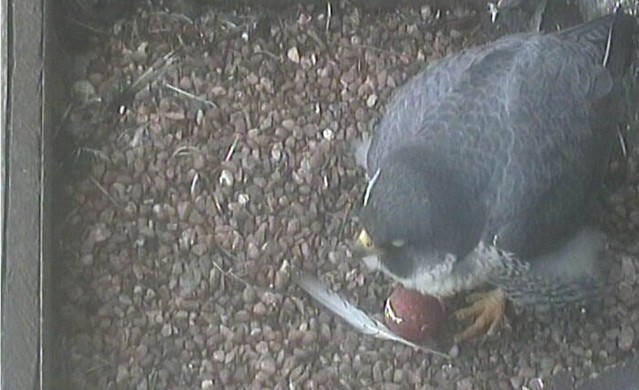
Update 1st May: Wendy Bartter captured this screenshot of the male with the four eggs last night about 8pm:

Male with the eggs captured last night by Wendy Bartter
to whom many thanks.


As we approach the time when we hope the eggs will hatch, we'll probably see our female get more and more fidgety as she begins to hear the chicks calling inside their egg shells. Perhaps she knows that hatching is getting close anyway....
We would expect the first egg to hatch early next week...but exactly when remains to be seen of course.
The egg shells either get partly eaten or eventually just crushed by parental feet. They disappear quite quickly.
Meanwhile chicks at other urban nests have hatched already and are growing day by day.
Wendy Bartter captured some remarkable behaviour in the urban nest at Sheffield which is well worth watching. See here. Thanks Wendy for sharing.
My hunch is that this could be the first time this behaviour has been captured on film anywhere in the world - but time will tell. I'm awaiting to hear from some peregrine experts to whom I've sent the link so let's see what they say.
Meanwhile Kate in Devon sent this link to an incident in Devon some years ago - see here.
Sadly the chick in this case didn't survive but the parent made a valiant attempt to rescue it for sure.
Hopefully this very unpleasant cold weather will have passed before our chicks hatch though our birds are such good parents they won't allow any chicks to get cold. The forecast suggests it will be warmer in Derby by Monday. It needs to be, especially for smaller birds which must be struggling to keep their eggs or nestlings warm and fed or to look after already fledged young.
And what about the recently arrived migrant birds like swallows and warblers which depend on a supply of insects? They can stand short spells of cold weather but this one has gone on too long already!
Nick B (DWT)

Ps. If you live near Derby, don't forget to buy your tickets for David Lindo's talk on Urban Wildlife in the Cathedral on June 8th as part of Derby Book Festival. Details are here
David will include a section on our Derby falcons who he came to see a few years ago. He dedicates a few pages in his book to his visit to Derby on which he was accompanied by Nick Moyes and me. For more on his book, Tales from Urban Jungles, see here.

Monday, 4 April 2016

Clutch completed...and news of the David Lindo Talk


Update at 26th April: we've had some very unpleasant cold winds these last few days with fierce hail showers added in. Fortunately the wind direction has been North West so the nest has not been in the direct line of fire (or ice!) and everything seems to be running smoothly with the incubation. Wendy Bartter has captured video coverage showing the changeovers between the male and female over time. See here .

Update at 12th April:
judging by lots of helpful comments to this blog, the incubation period seems to be going smoothly despite some unpleasant easterly winds which have blown directly into the nest platform. 
At least it hasn't poured onto the incubating bird as it did in a previous year when she was totally soaked and the gravel was very slow to drain the water away. Let's hope the weather improves as we head towards hatching in early May.

Tickets for David Lindo's talk are now on sale
Please see our blog entry (scroll down to find it) about David's talk called 'Tales from Concrete Jungles' at the cathedral on Wednesday 8th June at 6.30 pm.
Full details of the talk and the special Watch Point that DWT will run beforehand are now available on the Derby Book Festival's website here from which tickets (£8 /£10 each) can now be bought. Project volunteers and staff will be on hand with a display and a monitor showing the live web cams to the audience as they arrive...so do come and meet us if you can!

David's Book
If you don't live within reach of derby, or even if you do, David's book, Tales from Concrete Jungles (see here) is available in kindle and hardback versions. It includes a few pages about David's 2010 visit to Derby and his encounter with us and with our project.


Our female laid her fourth egg this afternoon (Monday 4th) so now her clutch is complete.
Some screengrabs have been sent in by Wendy Bartter, Yvonne Harvey and Helensara to whom many thanks.
Now the long incubation period starts in earnest and will last for about 30-33 days. Hatching will take place hopefully in early May.


Four super eggs - on Monday afternoon!


And here's a video clip captured by Wendy Bartter and taken about the time the egg was laid. As she says, there's no great reveal, just brief glimpses of the eggs.

Donations
If you have enjoyed watching the egg laying sagas, then please consider making a donation to the project which no longer has any lottery funding and so relies more or less entirely on donations. the hosting of the web cams costs about £1500 each year for a start!

Click on the 'Donations' tab on the blog which explains the various ways to send money across.
Many thanks in advance.
Nick B (DWT)
Note that Derbyshire Wildlife Trust manages this project on behalf of a partnership between the Trust, Derby Cathedral, Cathedral Quarter and Derby City Council. DWT holds and manages the project finances.

Saturday, 2 April 2016

Third egg and now a fourth1

Update 4.47 pm Monday 4th April: 'dutch eagle fan' reported seeing a fourth egg at 15.22 pm and this was confirmed an hour later when she got up and flew off, leaving all four eggs on show! Photos etc to follow when we get them.It's been a day of heavy hail showers in and around Derby today....though the nest has remained more or less dry since the wind is from the SW.

We now have three eggs, as shown by this screen grab, captured this morning  (Saturday 2nd) at 9:30am.
The smaller male or 'tiercel' (left) takes over incubating the eggs -
the larger female (the 'falcon') then flew off.


Comments left on our blog at an earlier changeover suggest there were only two eggs this morning at 08:00
.
Our records show that the Derby pair have, without fail, laid four eggs each year. However not all of these survive to either hatch or reach their first year. See the FAQ tab on our blog's main page for a chart showing past events in the lives of Derby's peregrines.

Finally, thanks to Wendy Bartter who has been capturing the feed from our cameras and checked back this morning to see if she had caught the moment of egg-laying. Not quite, it seems, but very close.
(Wendy has now explained her method of capturing this footage in a comment to this blog post. Scroll to the bottom of the post and click on the word 'comments'. )

And a big welcome to all newcomers to this project blog and web cams. Do post a comment to the blog and let us know where on the planet you are watching from!


Peregrine eggs look white under infra-red light at night-time!


Monday, 28 March 2016

Easter Egg and now a second one

Latest news 8pm Wednesday 30th: we have a second egg, first reported by the blog comments received (for which many thanks). It was laid about 7pm today. This screengrab photo taken by Kate clearly shows the second egg! (Thanks Kate):

And then there were two.......screenshot by Kate

The video below was captured by Wendy Bartter to whom many thanks:

Here's the original text written on Monday after the first egg was laid:
It's always nice to receive an egg at Easter-time. After leading us a merry dance, our falcon finally laid her first egg today, just around 1pm.
Over the last few days she had repeatedly visited the nest platform, spent a while scraping in the gravel, then standing over it for a while longer. This lunchtime however she looked distinctly like she was about to lay, and after a while of searching through the camera recordings we could confirm she had definitely laid between 12:58 and 13:05, though there was little sign of the egg itself.
Camera 2 gave the best view a little while later, and the second photo below was captured as a screenshot and uploaded to Flickr by HelenSara729. We'll upload a second video later today.

Because of he cold, damp weather, we should expect her to spend some time on the eggs, although in fairer weather it is not unusual to see the egg or eggs apparently abandoned for some considerable time. Incubation proper does not  occur until the penultimate egg has been laid - and this delay in development ensures that all the eggs hatch out around the same time.


Peregrine Egg 1 28th March (2.15pm)


Screen Shot 03-28-16 at 04.57 PM

Sunday, 27 March 2016

A merry dance and a welcome to newcomers.

It seems to be an Easter tradition for Derby Cathedral's peregrines to keep us all waiting for the first egg, when so many other peregrine pairs around the country have already laid.

It looked last night as if she might lay, and then again this afternoon it was nice to see her in the scrape leading us to believe the time was upon us. But as the pictures below show, we are still being led a merry dance, and are still waiting.

We have three out of our four webcam streams working right now, with Cam 4 providing both sound and video. Once it has timed out, refresh the screen with F5 to get it to play again. If you see anything of interest, do please leave a comment with the time stamp from the webcams - this helps us try and retrieve any video footage to share on this blog.
And it is an appropriate moment to welcome all newcomers to this project such as Leanne and also Vicki in Canada. Both left messages on our comments facility (see foot of every blog post, their comments can be seen on the previos post).
If you would like to send in a comment telling us where you are watching from it is good to know that our worldwide reach continues. If you scroll down the blog on the right hand column you will find a Clustrmap which, on double clicking, shows not only where people are watching across the globe but also lists every country and the number of hits.
Since 2007 when the cameras were installed, we have had over 33.5 million hits from well over 70 different countries!
Since 1st January this year we have had 59,000 hits from 40 countries. Most hits are naturally from the UK (6720) followed by the USA (466) and Holland (147). In the last half hour we've had visitors from San Francisco, Biggar, Wisbech and Nottingham to name but a few!

Posted by Nick Moyes and Nick Brown


Thursday, 24 March 2016

Will we get an Easter egg?

(Blog post updated with video)
With Easter being so early this year we stand a better than evens chance of getting a first egg laid before or over the weekend than in most other years.
For some unknown reason, our Derby female, despite having laid eggs in ten previous years, lays rather later than many other presumably younger females elsewhere.
Already as I write this on Maunday Thursday (24th), we hear (thanks to our super-comment sender Kate in Devon) of eggs at Nottingham (4), Sheffield (3) and Exeter (1).
The last two years she had laid her first egg on 29th March (ie next Tuesday) so perhaps she will just 'miss the boat' as regards Easter.
When she does lay it will be her fortieth egg....quite some achievement!
Usually she lays during the night and therefore under the infra red camera lights which make the eggs look white.
In fact, peregrine eggs are usually a lovely brick red colour when seen in daylight, with varying amounts of darker blotches.
Four clutches from a collection in the British Museum
Our female has laid four eggs every year since 2006, her first, when she probably laid three (she certainly reared three chicks). That year there were no cameras so we can't be sure there wasn't an addled egg which failed to hatch, and the birds' legal protectoin prevented us from looking over the top to count them from above.
The gap between eggs is usually about 2-3 days so her clutch will not be complete until over a week after she lays the first egg.
Full incubation doesn't start until the last egg is laid, though she may spend time covering her eggs before that if the weather is particularly cold. In fact, the early eggs can withstand going cold so we don't need to worry about them being left uncovered.....it is normal peregrine practice to do so!
This delayed start to egg incubation means that the eggs all hatch out more or less together, though sometimes there is one which takes longer to chip.
However. peregrines are great parents and will ensure that even a smaller chick gets fed and thrives.
Of course, we shouldn't really count our eggs before they hatch...and certainly not before they are laid, so we need to watch and hope that we do indeed get an egg for Easter (or soon after!).
No doubt our eager web cam watchers will put up comments as soon as anything happens. So keep an eye on the comments as well.
Some clever viewers have even been capturing their own screenshots and videos of the webcams. This one by Wendy Barrter was shared on YouTube: 


Nick B (Derbyshire Wildlife Trust)


Friday, 18 March 2016

Does our 030 think she's an osprey?

The latest news of 030 (the colour ringed female that fledged from Derby Cathedral's nest last June) came in an email from John Wright yesterday.
John is a key player in the amazing osprey reintroduction project at Rutland Water.

John contacted us in the autumn with photos and a video of 030 which featured on this blog here.
John's latest email says:

"030 is still present most days on Lagoon 4 at our Egleton Nature Reserve. I haven't seen any other Peregrines associating with her.
Her most recent kills have been Common and Black-headed Gulls, Lapwings, Wigeon, Mallard, Moorhens, Coot and Oystercatchers.


We renewed the Osprey nest/platform that is on Lagoon 4 yesterday. This has been her favourite sitting place for much of the winter. It had lost most of its sticks and nest lining but is now in tip top condition. 030 went straight on to the new nest today, excitedly playing with nest lining. 
030 sitting proudly on an osprey platform
She's too young to think of nesting herself  but clearly
enjoys the view from this mega nest.
Photo: John Wright

A four year old male Osprey (51) spent much of last season on this nest platform but failed to attract a female. It will be very interesting to see what happens if/when he returns to his nest in the next few weeks and finds this squatter on the nest......very probably fireworks!"
030 this time on an osprey perching post nearby.
Burley House looks close by but is a mile away on a hilltop!
Photo: John Wright.

Many thanks to John for keeping us briefed about 030. How exciting to discover what one of our fledged birds is getting up to - and where!

Nick B (DWT)