Peregrine Falcons first nested on Derby's Cathedral, England, in 2006. Our Peregrine Project is now run by a partnership between Derbyshire Wildlife Trust, Derby City Council, Derby Cathedral and the Cathedral Quarter. Here is what's happening in 2026. . .
We've just seen signs of a second egg, which was laid at 19:30 local time. Once again our wide-angle nest camera captured the moment in sound as it fell to the gravel floor of the nest scrape. So the gap between eggs one and two was about 53 hours, ie just over two days!
Egg no. 2 - laid around 19:30pm on 31st Match 2015
Seen at night-time under infra-red illumination, a peregrine egg looks white
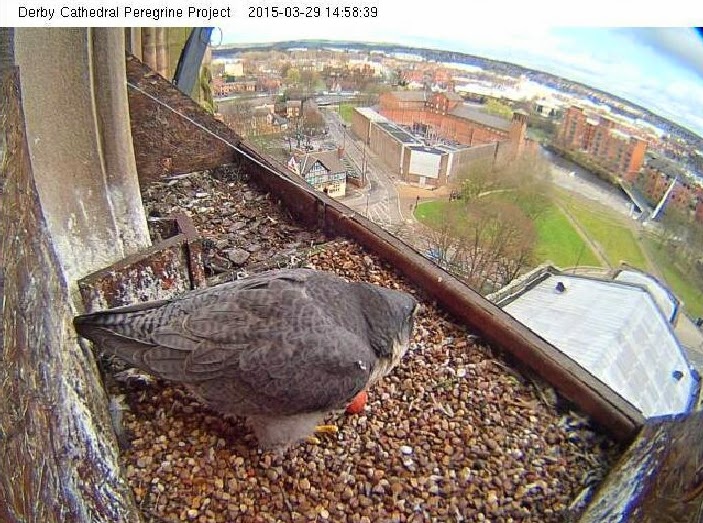
Falcon with egg, two hours after it was laid, on 29th March.
(Post Update: New video added)
At last we have an egg!
It was laid at 14:12 local time, today - just twelve hours later than last year. The screenshot below was captured by Phoebe, one of our regular webcam-watchers, and posted to Flickr. It was the first image captured by any of our viewers (including the Project Team!)
Screen shot immediately after egg-laying. Captured by Phoebe.
With this cool, windy weather, we may expect our female peregrine (known as the 'falcon') to remain with her egg to keep it warm. However, it is quite normal behaviour for the birds to leave the eggs for some considerable time until all but the last egg is laid. This has caused some viewers in the past to wonder whether the nest has been abandoned, but this is not the case. It results in all the eggs remaining cool and not developing much until the final egg is produced, so causing all the eggs and subsequent chicks to develop at the same speed and be at exactly the same stage at the same time.
We'll post more pictures later on if we have them.
Definitely no egg at 14:07 today, but then . . .
. . .with her back firmly set to our new nest camera for over half an hour after laying the first egg of 2015, this was the first glimpse the Project Team managed to capture.
The movement detector inside our Axis P3364-VE IP camera caught the actual moment of egg-laying this afternoon. Right at the start of the clip, look for the shadow of the egg dropping, and see if you can hear the dull thud it makes as it hits the gravel.
Following questions and discussion on the blog, this post aims to explain where everything is on the cathedral tower...especially for newcomers and people who don't know Derby Cathedral.
View of the East face of the cathedral tower
As you can see, the tower camera, (or 'pudding cam' as it has been called) is sited looking horizontally across the stone ledge well above the nest, with a view of Jurys Inn in the background. The three 'bumps' along that ledge are actually the 'rear ends' of three mythical beasts or 'grotesques' which the 16th century stone masons carved and fitted when the tower was being built. each grotesque has its head at the bottom and its bottom at the top! Those 'bottoms' are rounded and make ideal perching places for the peregrines. The right hand one is arrowed in the photo. The other two appear as black lumps to its left. If they had been carved with holes through their mouths to drain rain water from the roof, then they would be called gargoyles...but because the water is drained by a couple of lead pipes (in one of which, the left one, sits the pud cam) they are strictly 'grotesques'.
Am I a dog or what?
The large 'window' is actually filled with louvred wooden slats rather than glass, with wood behind to prevent any access by pigeons or indeed peregrines! The nest platform was screwed into the woodwork, carefully avoiding drilling or making any marks on the stonework on this Grade 1 Listed Building!
Looking down on the nest platform in winter
This photo, taken by Nick Moyes one December - and well before the nest clean-up, shows how the nest platform fits snugly around the stonework of the cathedral.
If you want to try a bird's eye view, try this aerial map, which allows you to view the cathedral from any direction. (Note that nearby Jury's Inn was still under construction when this picture was taken, and the re-laying out of Cathedral Green was also in progress.)
We hope this allows web cam viewers to understand the layout...let us know if not!
As you can see, the nest has been cleaned and the cameras checked for the start of what we hope will be a successful tenth breeding season for our peregrine pair. Thanks to Nick Moyes, assisted by Ian Layton who we now know will be back with us for his third summer as Engagement Officer (part time) running the Watch Points among other things.
We are confident that these are the very same birds that originally colonised the tower back in 2004/2004.
Nick Moyes has abseiled down the tower to the nest platform many times since it was installed in 2006
So the next question is: when will we get our first egg?
The Nottingham pair have just laid theirs but a pair in London were the first to lay an egg in the UK, doing so on 7th March - which is really early!
Four clutches of peregrine eggs
Last year our first egg was laid on 29th March. The earliest ever at Derby was in 2010 (23rd March) and the latest was in 2013 (on 4th April - the year of the late snowfall!).
Eggs are then laid at about two day intervals but not incubated until the third or (more usually) the fourth egg such that they all hatch about the same time.
Last year Ian Layton, our HLF-funded People and Peregrines Engagement Officer, with the help of a small group of dedicated teachers, prepared a number of Peregrine Resource Boxes for use by schools in the county and city.
These boxes contain a whole host of things to help you use these magnificent birds, the web cams and the blog in your curricular work. And they are entirely FREE to loan!
Contents of a resources box displayed
If your school is one run by Derbyshire County Council, then Georgina Greaves at the council is the person to contact if you want to loan a box. Boxes are delivered to your school via the normal channels. Georgina can be contacted by email at environmentalstudies@derbyshire.gov.uk or on 01629 533439.
An imaginative menu for a peregrine!
Four red eggs drawn by a child at an infant school.....
If your school is in Derby City, please contact peregrines@derbyshirewt.co.uk and we will arrange for you to have the single box that serves the city.
Nick B (DWT)
Ps. Ian will be starting work with us again within the next few weeks. Hurrah!! We also plan to put some of these school resources online, too, for anyone to use.
PLEASE SCROLL DOWN THE BLOG TO SEE A RECENT VIDEO CLIP OF OUR BIRDS COURTING......
As the nesting season approaches, we once again see typical courtship behaviour on the peregrine falcons' nest platform. Thanks to an anonymous commenter, who very helpfully left a note to say they had observed interesting behaviour at 13.55 on 12/2/2015, we were able to retrieve from our camera the short video clip below. This is quite typical of their courtship routine, and suggests we are yet again on track for a successful nesting season.
The second clip was captured just 20 minutes after sunrise on 17th February 2015. The much larger female is in the nest scrape on the right hand side, although this wide-angle perspective does make any object not immedately under the lens look so much smaller than it really is.
Please leave a comment on this blog if you observe activity worthy of sharing. Date and exact time are really important to help us retrieve the relevant video clip.
PS:. And a big welcome to any newcomers to this blog and to the web cams, especially if you were at the talk in Loughborough last Friday (attended by over 100 folk). The smudge on the camera lens will be cleaned off by Nick Moyes when he abseils down to the nest to clean it up and check and clean the cameras, sometime in the next 2-3 weeks.
Pps. Nick has put over 50 video clips on You Tube since he set up the cameras in 2007. They show all aspects of the peregrines' lives including bringing prey back, courtship (as above), egg laying, hatching etc.
To find them, use the QuickLink at the right side of our homepage. Or put VC57UK into a search once you are on YouTube. If you want one topic, such as egg laying, the put 'Derby peregrines egg laying' into the search box.
Over the last few weeks we've been seeing our adult peregrines spending more time together, and certainly more time nearer to their nest site half way up the tower of Derby Cathedral.
A view of Jury's Inn from the traffic lights by Queen Street in Derby.
On many occasions in recent days I've had to stop at traffic lights by Queen Street on Derby's inner ring road. There it's possible (if not driving!) to look up and see either one or both peregrine falcons atop the huge blue 'Jury's Inn' lettering advertising the hotel's name. From there the birds have a clear view of their nest site, as well as the ability to bask in the warm sunshine from the south.
With courtship displays and heightened nest activity nearly upon us, the Project Team have turn on 'movement detection' on our wide angle nest camera. This can be set to look at different areas of the field of view and to automatically save a short video to a memory card within the camera. This can then be remotely downloaded and checked for interesting happenings. It can be a slow process to check them all, but sometimes it yields interesting events, like this one just as the bells were ringing at 4pm this afternoon. This really gives you an idea of how the nest scrape gets its name.
We shall be seeing a lot more of this kind of preparatory action over the next few weeks. If you spot something you think we ought to see, do please help us by noting the exact time stamp on the webcam screen and leaving a comment on this blog. We can then do our best to check whether the moment you saw has been captured, and to share it for all to see.



.jpg)


