Thursday, 13 March 2014

Massive fire in Derby does not affect our birds and some new school resources

IMPORTANT NOTICE: last Friday (14th), a massive fire destroyed the top of the Assembly Rooms Car Park near the cathedral. As a consequence, equipment on that building used to relay signals from the cathedral to the internet were damaged and our the web cam connectivity went down. Rest assured the cathedral was NOT affected and that our birds are safe (see below).
Today, by a miracle of technology, the connectivity has been restored back to how it was! However please note that we still have technical problems with streams 3 and 4 and it may be awhile before they are sending out streaming images.
The Project Team

Smoke rise up but stays clear of the cathedral Andy Trenier


View the peregrines had with the fire just out (Andy Trenier)

The scene the morning after the fire. (Nick Brown)

The male looks fine - taken a few days after the fire (Andy Simpson)

For almost a year now, Ian Layton, our Engagement Officer, has been working with a small group of teachers and the county council's environmental studies services manager, Georgina Greaves, to prepare a number of resources boxes for loaning to schools both in Derbyshire and in Derby City.
These are now ready and are FREE for local schools. MORE ON THIS TOPIC IN THE NEXT POST.
Nick B

Update:
A peregrine bathing - a rather good video taken in Somerset is at http://youtu.be/QV1HGxT4dio

First UK (urban) eggs of 2014: a pair of peregrines in London have started to lay their eggs with the first last Friday/Saturday and a second and third during the week....at Charing Cross Hospital: https://www.facebook.com/FaBPeregrines . This pair was very early last year too.....

Wednesday, 26 February 2014

Clean up day

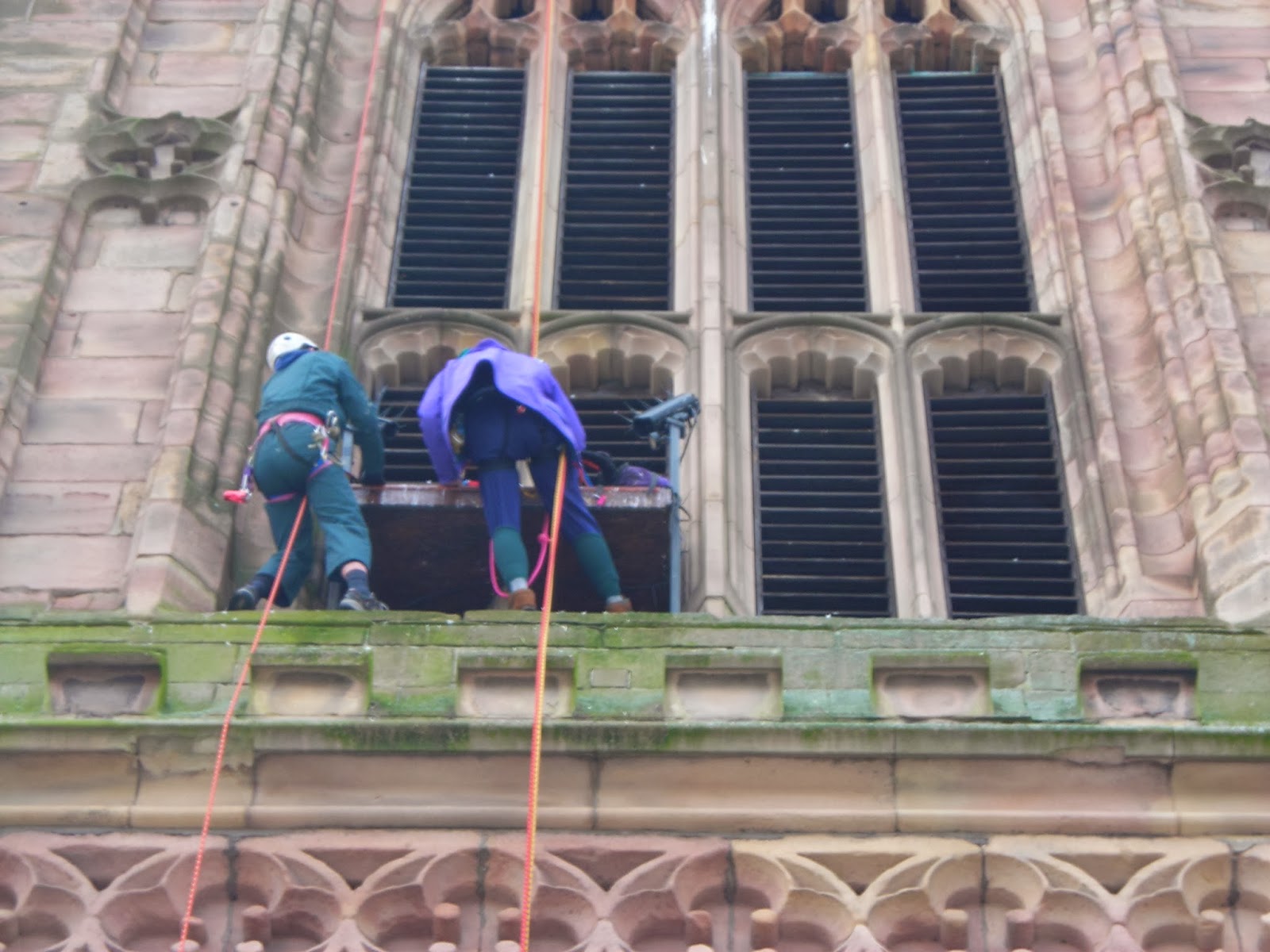
Today (26th Feb) was just the day to get the annual clean up done. Nick Moyes, abseiler in chief, had a free window in his busy life and he and I assembled mid morning. The sun shone above us but there was a strong, blustery wind. Fortunately it was blowing from the west - the East side of the tower would be much calmer and so it proved.
Simon O'Connor, the local Wildlife & Rural Affairs Police Officer, was very keen to watch proceedings so he came up to the top of the tower with us but had to attend to other duties before Nick abseiled down.
A policeman's lot IS a happy one (sometimes!)
(Before Nick arrived, I had watched the falcon pair displaying to each other on a stone ledge below the nest. Both birds looked in good shape. Facing each other, they were bowing and 'e-chupping' - a noise they make to each other during courtship).
By the time we had reached the top of the tower, both birds had departed. Later one was seen on Jurys Inn.
Having carefully checked all his climbing gear and his ropes, it was time for Nick to climb over and descend....
Time to drop down to the nest

The cleanup operation went smoothly if slowly. The newest, wide angled camera was lifted up a couple of inches (you may recall that the youngsters did their disrespectful best to stop us viewing them last summer!) and all three camera lenses were cleaned. Old prey remains were removed, new slate was added to the non-nesting side of the platform and the whole area was sprayed with a mild anti-bacterial fluid.
Nick working at the platform
After some 90 minutes the job was done and Nick could drop down to the nave roof below. Although feeling slightly chilled he was pleased to be able to get his climbing harness off! A visit to a local hostelry soon revived him.....
With luck, you'll notice a marked improvement in the web cam views. 
Soon, once a small technical glitch has been sorted out, we will be able to get live streaming up and running. This costs quite a lot of money so we cannot afford to keep it running during the 'off-season'.
Incidentally, the only prey item I could see from the top of the tower was a lapwing, cached close to one of the lead gutters. Tomorrow's dinner perhaps.
Complete lapwing saved for a rainy day.....
With luck, the adult pair will be back tomorrow to inspect the spring cleaning operation. We hope they are impressed! 
On Friday and again next week, we have more meetings with our Rolls-Royce team to discuss their latest ideas (please see the previous blog post). The team members have split into two sub groups, dividing up the four tasks between them.
Nick B (DWT)

Thursday, 20 February 2014

Rolls-Royce is on our case

As many of you will know, Rolls-Royce is based in Derby and has some 15,000 employees working there. Each year, new apprentices and graduates have the opportunity to carry out a project in their work time which will help one or more local communities or charities.
Last summer, along with other local community groups and charities, we were invited to suggest how a small team of young professionals, each contributing three hours per week between January and September 2014, could assist us.
Any final ideas agreed upon would be mutually beneficial for both parties: the Peregrine Project gains an enthusiastic and motivated team for nine months and  the company has a chance to help the local community with their team experiencing challenges they would not otherwise come across during their professional careers (and meeting some very different people too - starting with Nick M, Ian L and me!).
While we knew that the Community Investment team at Rolls-Royce really liked our proposals, we also heard that they attracted a great deal of interest among the apprentices and graduates (who are allowed to choose which project they want to work on).
Finally, in January, everything fell into place and we had a very successful first meeting with our team of  thirteen young professionals.  We discussed the general background to the Peregrine Project, what we have already achieved since 2005/6 and what we plan to achieve during and after the team’s nine months with us. We followed this by taking the team up the tower and onto Cathedral Green to look at the nest platform from below. Unfortunately the falcons chose to absent themselves, so our new colleagues had to imagine what a peregrine would look like were it perching on the edge of the nest platform! They did however enjoy the views from the top of the tower, including a splendid rainbow!
A tower-top view down St Mary's Gate (albeit in autumn!)
There are four tasks that the team will tackle:
The first is to think about how they can embed the peregrines and the project more deeply into the life of the city. Initial ideas have included opening an exhibition, setting up interpretation panels near the Cathedral to catch the eye of the passing public, putting peregrine logos on local buses or even creating a structure or sculpture that would make passers-by think of the birds that live way up above their heads.  There is a huge opportunity to expand the ways the team can raise awareness of the peregrines, rather than relying solely on the display that will be set up again in the cathedral shop window in the summer. The team will focus on generating ideas and then researching, developing and evaluating potential options – which they will present to us along with their recommendations later on.
Stylish interpretation on Cathedral green - but no mention of our birds (yet!)
The second task is for the team to help Ian Layton, our seasonal Engagement Officer, with his work of engaging people with disabilities and those from minorities and other ‘hard to reach’ communities - using links that must exist within the Rolls-Royce workforce.
Their third task is based around bird aerodynamics and devising ways to teach children about how birds and planes fly – which seemed very appropriate to them and to us (they are already researching how the baffles in the falcon’s nostrils might work!) The team will develop work sheets for schools and even for higher education as well.
Bird with an extra pay load.....Photo: Jon Salloway
The final task for the team to look at is how they might evaluate and increase the economic value of the Peregrine Project to the city.
So this new Rolls-Royce team has plenty to do and we are really looking forward to working with them throughout the coming season.
We’ll keep you informed from time to time as things progress....and we might even allow them to post to the blog too!
Nick B (DWT)

Saturday, 25 January 2014

Let courtship begin....and two footnotes!

As we progress towards February and the weather remains mild, we can expect to see our adult birds spending more time on the nest platform.
Currently it needs a bit of a 'spring clean' - as do the cameras. So, sometime next month an abseil will be arranged to carry out the necessary annual maintenance work.
January 2012:  preparing to abseil down to clean up the nest 
First, the prey remains will be collected and lowered down to the nave roof for later analysis. Second, the gravel will be refreshed and treated with an anti-bacterial spray. Third, the platform will be thoroughly checked to make sure it is in good shape and that the drainage holes are clear. Fourth, the cameras will be cleaned and re-adjusted. And finally, the abseilers will drop down onto the nave roof below, keen to get inside and warmed up!
Cleaning up the platform 2012

The peregrines take little notice of all this activity and usually return to the tower later the same day. How lucky they are that their nest gets such VIP treatment!
If you have not seen the adults displaying to each other and also scraping out a depression in the gravel then there are several video clips from previous years available on You Tube. Search for VC57UK on YT and all the 50+ video clips should appear together such that you can select the one you want to see.
Job done! So down to the nave roof......

The other way to find the clips (and the blog posts which describe what's going on) is to scroll down this blog looking for the 'SEARCH THIS BLOG' window on the right hand side. Put 'courtship' into that search and several posts will appear, most with the relevant video clip right there, ready to start.

If you see nest scraping or head bowing/courtship displays in the next days and weeks then please do put a comment on the blog so we know what's happening. If it is a really good sequence we may even be able to convert it into yet another YT clip!

Footnote: taking some folk up the top of the tower the other day, we noticed three men on the top of Jurys Inn just above the two falcons. Whether they could see the birds (and visa versa) I'm not clear but they certainly weren't far away were they?
Photo by Abi Ashley
Second footnote: Feb 4th - Not for the faint hearted!
Soon after coming down from the tower this afternoon (and failing to see any peregrines on Jurys Inn to which they normally repair if anyone is on the tower) we photographed this abseiler trying to re-adjust the JI lettering. 
From that position there is a sheer drop of over 200 feet (in old money).
This may explain why our birds had gone temporarily awol! One was back later....so nothing to worry about......
The Jury's out .....of line!
Even this photo doesn't show the whole drop!


Wednesday, 1 January 2014

Writing about peregrines - and painting them


With the nights at their longest just now and not a huge amount happening on the web cams, here are a few reading suggestions (and some art) that might entertain you through these dreary January days.
First, the peregrine 'bible'; The Peregrine Falcon, by Derek Ratcliffe (Poyser) is undoubtedly the most comprehensive and authoritative book on peregrines ever written. Sadly Derek is no longer with us. He would have been delighted by the opportunities provided by modern web cams to examine closely the intimacies of the lives of these iconic raptors!
Published by Poyser and now out of print
Derek Ratcliffe's book is a scientific one, full of facts, tables and details about peregrines and their lives. Incidentally the wonderful artwork is by Donald Watson, a Scottish artist who died a few years ago in his eighties.
For a (much) more readable text, try a book regarded as possibly the best piece of nature writing ever to have been written. J A Baker wrote The Peregrine in the 1960s, having 'set out to track the daily comings and goings of a pair of peregrine falcons across the flat fenlands of Eastern England' (Essex mainly). The book was published in 1967 by Penguin in the UK and by Harpur and Row in The States. Baker, a reclusive man, also died a few years ago.
Cover of the new edition, painting by Elizabeth Frink
A further book to delight in is The Peregrine by Charles Tunnicliffe, also now out of print. It is full of Tunnicliffe's writings, paintings and engravings entirely focused on the peregrines he watched at South Stack on Anglesey over forty years ago.

And here are some more peregrines painted by other wildlife artists that you might enjoy:
This painting is by Mike Warren, a Nottinghamshire based artist
This is by Noel Cusa, a disciple of C F Tunnicliffe.
Note the accompanying sea pinks and navelwort.....

This composite sketch by Darren Woodhead shows a peregrine 
chasing a flock of knot and catching one

This is by Darren Rees. The bird appears to be dozing in the sun
All these artists were (when alive) or still are members of The Society of Wildlife Artists (SWLA). These are artists who really get to know their subjects by studying them in the field where sketches are made before returning to their studios to make finished work. To see more of their work and that of other members go to http://swla.co.uk/ . They hold an annual exhibition in London each autumn - well worth going to. It costs only a few pounds to get in.
Incidentally, more of Charles Tunnicliffe's work can be seen on this website - http://www.thecharlestunnicliffesociety.co.uk/
Nick B (DWT)

Tuesday, 31 December 2013

Some other peregrine sites

Here are six photos of other places where peregrines either nest or have been seen perching over the years .....maybe you can name them?
No. 1 - on the eastern side of the UK

No. 2 peregrines have been recorded here since the 16th century but don't breed
No. 3 Not such a pretty building........and not that far away
 No. 4 The first site with a peregrine web cam in the UK though it didn't last
No. 5 This is very difficult but the town has connections with a certain Iron Lady

No. 6 Peregrines only perch here but they nest nearby


No prizes for guessing the answers but it may amuse you while you are pondering the New Year (and do have a Happy One!). I'll put the answers on here tomorrow evening....if I remember!

Nick B (DWT)

Thursday, 12 December 2013

Pellets

Here's a photo of a peregrine pellet I found recently:

The pellet is about 6 cms. long and 2.5 cms. wide
Peregrines 'cast' pellets through their beaks from time to time to eject both feathers and bone fragments they have swallowed. They are usually fairly dry and grey in colour.
Has anyone ever seen one of our peregrines casting a pellet? (I suspect they don't cast pellets into the nest box but do this activity elsewhere such as above the nest on a ledge.
The bird makes movements which resemble coughing or choking as the pellet is brought up and dispelled.
Only rarely do peregrine pellets contain anything identifiable of interesting. Sometimes if you were very lucky you might find a bird ring inside - but, despite looking many times - I have never done so yet.
(Incidentally, bird pellets don't smell and are usually dry or dryish. Many species - especially those that eat hard objects or use grit/stones to aid digestion - will cast pellets. The species known to cats pellets include robins, rooks, bee eaters, owls and most birds of prey among many others).
You may have heard how owl pellets contain the (often identifiable) bones of the small mammal and other prey they have eaten making them valuable tools in identifying exactly what the owl has been feeding on (see http://www.kidwings.com/teacher/owlpellets/bonechart.htm.)
This is because owls eat the whole prey including the skull and fur/feathers. When the bones (especially the mammal skulls) are extricated from a pellet they can be identified to species making owl pellets a rich source of information. 
By contrast, peregrine prey is usually too big to be swallowed whole so we don't find any skulls, beaks or legs in them.....maybe a bone fragment or two but usually completely unidentifiable broken up feather remains. 
Nick B (DWT)