
It's funny how some of those odd facts and bits of information picked up from school can linger throughout one's life. I remember learning about volcanoes in school, and delighting in the sound of the name "Popocatepetl" which rolled impressively across my schoolboy lips. I remember, too, learning which creature was the fastest on earth - the peregrine falcon when dropping or "stooping" down on its prey. Both those things stuck in my mind for some reason.
It's also funny how seemingly unrelated things can come together many years afterwards. And so it was that late last year I found myself on a mountaineering trip to Mexico to climb some of that country's highest volcanoes. The famously-named volcano, Popocatepetl, was on our doorstep but still erupting (as you can see above) so was unfortunately out of bounds. But as we waited in the office of the Iztaccihuatl -Popocatepetl National Park for our permit to enter, my climbing partner and I found ourselves chatting to some of the enthusiastic Park staff. Explaining our interest in mountains, wildlife recording and webcameras, we learnt that peregrine falcons were present in this National Park, but were regarded as both extremely rare and still endangered there. I had been watching their Popo webcam from my office computer, and they now took to watching our peregrine webcam from theirs!
We never did see a peregrine falcon in Mexico, but came back excited by our experiences and the friends and contacts we had made. Back in England attention is turning to the coming breeding season. The nest platform will need to be checked before too long and the cameras adjusted. We'll do this before nesting starts, and the disturbance will be minimal. Already we've set our visitor counter back to start counting again from 1st January 2009, having taken over 430,000 unique visits during last year. Who knows what successes or failures this coming season may bring?
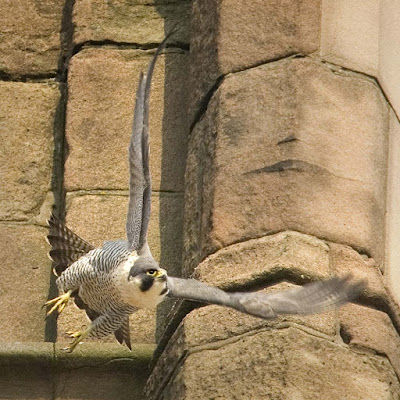
For keen watchers wanting to distinguish adult peregrines from juveniles, here's a quick reminder: The adults have horizontal streaks across their breasts, whereas juveniles have vertical streaks running up and down. The adults have blue/grey feathers on their head and back, whereas juveniles are a dark brown colour.
Place your mouse over each image to view captions, or click image to enlarge.
In the breeding season the adults both have yellow rings around their eyes. This is most apparent in the male, but is increasing in the female as she gets older. He is considerably smaller than she is, but this is of little use when only one bird is seen at a time on our webcams. It can also be diffiult to judge size when one bird is nearer the camera than the other, and in cold weather both birds can fluff up their feathers and look much larger than they did before! Look out from January oonwards for the two birds facing each other, doing a heads-down display over the nest scrape. This is part of the courting ritual and our webcams then allow you to clearly see the smaller male against the larger female.

We should also point out that our young birds have not been seen around the Cathedral since autumn last year, so any bird you see now will definitely be one of our adults which first started breeding here in 2006. And once eggs are laid and incubation starts, it will be the larger female who we'll be seeing for most of the time keeping them warm.

Whatever happens during 2009, we'll bring you all the news, and no doubt readers will continue leaving helpful comments to report the things they see, too.
Nick Moyes
Derby Museums & Art Gallery
Website feedback minisurvey
How did you find this site, what were you looking for and what do you think of the experience?
Renaissance East Midlands works with museums to help them be the best they can for visitors, staff, volunteers and the community. We are keen to help improve museum websites by finding out how well they are meeting users’ needs at the moment.
Once you have finished your visit to this website, please spare five minutes to share your thoughts by filling in this quick survey. To say thank you for your help, you will have the chance to enter a prize draw for £100 at the end of the survey (July 2009)


