Showing posts with label schools. Show all posts

Friday, 5 February 2010

Cathy on a learning curve

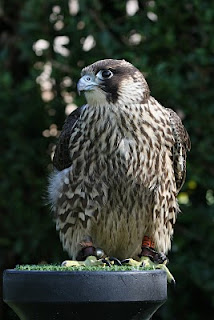
Last year, one of the four young, a female with ring number 010, was found on the ground and taken into care. Ex-rays confirmed that she had a damaged shoulder joint which was inoperable. She would never fly properly again.

Either she would have to be put down or be kept in captivity with a view to using her for educational purposes if she seemed up to it.

Fortunately, Colin, a local falconer, who had been going to the cathedral over the last few summers to watch and photograph the birds, agreed to take her in and look after her. He applied for all the necessary licences from DEFRA to allow him to keep a wild peregrine. He also gave 010 a name, Cathy.


Cathy took to captivity very well. Colin soon discovered that she could fly short distances though she was unable to gain much height.


So we decided to see how she would get on with small groups of school children and, after careful planning, took her to her first school last week.

We chose Brigg Infant School because the children there had been watching the web cams over the summer and had also paid a visit to the cathedral to see the birds. Over three years, their teacher, Helen Naylor, had successfully used the peregrine project to teach english, maths, computer work and many other aspects of the national curiculum. The children's wonderful drawings have appeared on this blog in the past.

With the necessary risk assessments in place, we took Cathy to the school last week. We put her and Colin in a separate room from the class and brought small groups of 6-7 children in to see her one after the other. The children were excellent, very quiet, attentive and asking good questions.

Cathy also behaved perfectly. She was very calm and relaxed throughout and Colin fed her from time to time. Fortunately we had placed a wipeable cloth on the carpet beneath to catch her projectile 'mewts' !

We hope to try her out with slightly older children in the next few weeks....

Nick B (DWT)
(Both photos of Cathy are copyright of Colin Pass)
To read about night hunting please scroll down to the previous blog entry.

Monday, 3 August 2009

A School's-Eye View

Whilst we wait for our wireless internet link to be restored, we would like to share with you a superb example of how a group of Derbyshire school children have engaged with our peregrine falcons this year. Red Class at Brigg Infants School have made and narrated this superb video. The voices you hear are children of five and six years of age. Helen Naylor's class have embraced ICT and wildlife in an absolutely stunning way, and it was a pleasure to meet them earlier in the year when they visited Derby.
Not only that, it neatly sums up the 2009 season from egg-laying to fledging.


Peregine Falcons at Derby Cathedral from Helen S Naylor on Vimeo.

Visitors to Derby Museum and Art Gallery can also see this video as it is currently on continuous play in the Derbyshire Nature Gallery.

We're always interested to hear of schools who have found our webcams of value in teaching, and welcome a chance to see examples of work produced.

Thursday, 14 May 2009

Schools and Webcams

Many local schools are avid watchers of Derby Cathedral's Peregrine Falcons, often watching the live webcam feed on their electronic whiteboards. Of course, most schools are blocked from viewing YouTube videos and blogs, which is probably a good thing bearing in mind some of the content we see. But many children do read this blog with their parents at home, and we welcome you all. (Perhaps grown-ups could bear this in mind when leaving comments that children might read? Technical terms can sometimes be a bit hard to follow)


Last year we reported that a number of schools across Derbyshire had installed nest boxes of their own, and had joined together to share images from their nest box cameras. It’s called the Derbyshire Schools Birdcam Project. This year even more have joined and all are now enjoying the opportunity to witness the nesting habits of birds at first hand.

Not every school has been lucky enough to have activity in their own boxes - that's nature for you. But they can all enjoy the successes of other schools through their project website and blog. Each school also has their own birdcam blog where children, parents and members of the community record their observations. All comments are moderated prior to publication online, of course.

Right now there is plenty to watch in the school boxes:
The first blue tit chicks hatched out over the May Day Bank Holiday weekend. This was followed by a succession of hatchings in other boxes including two great tit broods, with the final couple expected by this weekend. This year, the project schools are also enjoying images from a camera set up over a kestrel nest site at Povey Farm near Dronfield. Six eggs have been laid with the chicks due to hatch towards the end of this month."

Next week Derby Museum & Art Gallery welcomes the children from Brigg Infants on a school educational visit to trial run our new peregrine falcon teaching session. Here's some work they did based on our birds last year:


For schoolchildren it’s probably far more exciting to watch a blue tit feed a caterpillar to baby birds in their own school nest box than it is to watch peregrine falcons miles away up a Cathedral Tower. But all around us spring marches on, and very soon UK TV's annual "BBC Springwatch" will be starting. This is a two week opportunity for the whole country to stop what it's doing for one hour each evening and sit enthralled by some of the most amazing live views of UK nature that TV engineers can provide. Still not as good as your very own blue tits and peregrines, though!

________________________________________________
Here are some images uploaded by viewers to Flickr today.
First, a great compilation by showing how the chicks grow and develop so rapidly by rejsharp.

growing chicks

by rejsharp
Derby Peregrines 117

by Marski2009
14 may 09  tiercel and feral pigeon

Tuesday, 24 June 2008

Thanks from Schools - and some questions for teachers

Letters from a Stanley Junior School, Middlesex, UK. Click image to enlarge The school-children from Class 5JC At Stanley Junior School in Middlesex in southern England wrote to us recently. Thanks, everyone.

Shown below are a few extracts of the things they said. For other teachers reading this blog, we've included a questionnaire at the end which we'd ask you to complete and return to us.

Simone M: The parents were good when the babies were born, keeping them warm, the dad was going out and geting food to bring them. I have enjoyed waching them and found it interesting.


Stanley G: My teacher has been showing us the webcam of the peregrine falcons. They are very high up and always seem to be hungry. I am worried they will fall out of the nest. I would love a photograph of the peregrine falcons. I am sure my teacher will pay for it.
Lianne K: I am very very worried that they are too high up. They have a very dangerous nest they might die up there from the height can you do something so they don't fall out, and also I am worried that the bells might make the birds deaf.
George: I have learnt about them and know they are birds of prey. I have also learnt that they were very rare but now growing in numbers. Best of all I enjoyed watching the babies being fed by their parents.
Nassam A: My name is Nassam. I have enjoyed watching your video. I was worried the babies might fall down on to the street and die. I'm looking forward to watching more footage of the falcons.

I'm sure most of the readers to this blog -wherever we are in the world - would like to thank the children of class 5JC for writing to us. (They must all be around 9-10yrs old.)
The Peregrine Project Team were certainly pleased to hear from you, and we can tell you that the young chicks are very clever at staying on the nest ledge, and rarely fall out. But you'll have seen that a few weren't quite strong enough to make their first flight. (We have plans to stop that happening next year.) Of course, it helps to be up high, especially when taking that first flight - so we don't worry about that at all. Peregrines like being high up on cliffs and mountain tops, even if some of us humans don't! Nor should you worry that the Cathedral's bells may make them deaf. The bells certainly are loud, but not enough to damage their hearing. The birds seem to completely ignore them - and their hearing is still pretty good.

And from Red Class, Brigg School, Derbyshire:
Thank you for answering all of our questions. We were happy and excited to see them on the website. We learnt lots about peregrines. We enjoyed reading the answers. We are going to make a book all about peregrines. Our headteacher is going to put the name of the website on our school news letter. Some of the children have been to Derby to look through the telescope. They liked it when the birds were flying around in circles. We watched the video clips of the mummy bird feeding the chicks. They made lots of noise. Thank you very much from Red Class.
For teachers everywhere

If you are a teacher (anywhere in the world, but especially in Derbyshire) please have a go at completing this questionnaire which we hope may guide us to aiding more schools use our webcams. We want you to tell us what we need to do to help you take better advantage of them in class.

It's probably best just to cut, paste and edit the text in an email, sending your replies back to peregrines@derbyshirewt.co.uk.

1) Have you personally visited the Watchpoints or seen our peregrines for real? YES / NO

2) Has your school or class watched the webcams or used our blog? YES / NO
. . If YES, how often and in what way?

Once or twice / weekly / daily
General interest / Environment / Life cycles / ICT / Numeracy / Geography
Other-please specify:

. . If, NO, what are the constraints?
 Not aware
 Not relevant to teaching
 Too technical, or insufficient ICT resources
 Can’t view for technical reasons (sites blocked)
 Too distracting
 Other – please specify…

3) What would encourage you to use Derby’s peregrines as a teaching tool?
 Nothing – I use them already.
 A visit from an expert to talk to your class or assembly (Derby & Derbyshire schools only)
 A school visit to the Cathedral and Watchpoint (Derby & Derbyshire schools only)
 WEB: More background information on peregrines (FAQs)
 WEB: More help and ideas for teaching opportunities/links to National Curriculum
 WEB: Downloadable activity sheets
 WEB: High definition video clips on intranet/learning platform
 WEB: An hourly image archive for you to select, store and re-show images of your choice from any past hour, day or year. (if you like this idea, feel free to expand on how you might use it, or what functionality you might like to see)
 Other suggestions:

Would you be willing to pay for? (and how much):
Unrestricted access to live video feeds YES / NO
Classroom visits by experts with supporting material. YES / NO

Your Name:
Name of School:
Town/County/Country:
Age of Children Taught:
Would you like us to add your email to our mailing list for peregrine news and updates? YES / NO

Paste and edit in an email, sending your replies to peregrines@derbyshirewt.co.uk

Wednesday, 18 June 2008

Write You Own Caption!

Tiddler on The RoofTony the Head Verger from Derby Cathedral can be seen tonight on BBC "East Midlands Today" rescuing tiddler or "007" as described in the yesterdays blog entry.

We don't think he'll be demonstrating his water-skiing pose, as we see here. But who knows? Perhaps you can suggest a better caption for this picture?


How Wild is Your City?
Tonight at 7:30pm (18th June '08) there will be a short walk from Derby Market place to the river and back to the Cathedral to see how much (or little?) wildlife we can find. Join staff from Derby Museum outside the Assembly Rooms/Tourist Information Centre for this easy walk on mostly level ground, finishing with a peregrine watch, of course.
(I owe a small apology to all 35 people who turned up for this walk tonight: I promised to tell them at the end how many different plant species we recorded yesterday whilst walking in just a 300metres in any direction from Derby's Tourist Information Centre in our Market Place. The answer is: one hundred and twenty five! Nick M.)

Learning Outside the Classroom
And tomorrow (Thursday 19 June) school teachers are invited to call in at Derby Museum & Art Gallery for an event showcasing our new primary education services.

Drop in any time from 1pm – 7pm to find out what’s on offer and sample some taster sessions.
These new sessions include:
Secrets of the Mummies; Roman Derby; Vikings; Looking at Art; Habitat Heaven; Nature Detectives; Victorian Voyage; Houses and Homes; Time Travel Toys and Children at War.

Pupils will be demonstrating sessions from 1pm-3pm, and there'll be a chance to tell us what you'd like us to do to help you use the Peregrine Falcon project in your classroom.
(All teachers/teaching assistants who attend will receive a free voucher entitling their class to 50% off one of our new sessions.) Follow this link to find out more about Learning with Derby Museums

Friday, 30 May 2008

For Schools

This year's Peregrine Project has really taken off!
Our hit counters have reached the quarter of a million mark; our chicks are developing nicely; our third camera and live a/v stream is proving very popular; and our DVD on The Peregrines of Derby Cathedral is selling well, and receiving great feedback.

With Watchpoints resumed again, it's good to be able to talk and to meet with so many different people - some of them old friends from the last two years. Cameras as well as telescopes have been in evidence, and this fantastic picture sent to us by Graham Whitmore was a multiple exposure taken on May 18th.

One area of our Project that we'd all like to see take off in the years ahead is the use of our webcams and videos clips in schools, especially those local to us in Derbyshire. The educational potential is, as yet, almost completely untapped. But there are both technical challenges and resource constraints.

For example, many of our peregrine video clips are widely available on YouTube. But schools are usually banned from YouTube, so we thought we'd try and post some video clips directly into this blog. It took an age to get it to succeed, and we hope the clip below is viewable by everyone. It shows our four rapidly growing chicks being fed last week.


Schools in Derby should all now be able to access this peregrine diary, as our "blog" was specially unblocked after we made a request last year to the Education IT people. We know that quite a few local schools do now watch our webcams on the classroom "whiteboard". We'd love to hear more from schools about how you use us, or your ideas on what you'd like us to do to help you use our resources in the future.

Frequently Asked Questions

Recently, the children in Red Class at Brigg Infant School near Alfreton, Derbyshire, told us they watched Derby's peregrines in class. They emailed in some questions and we thought we'd make our reply more widely available by posting it here:
How often do the chicks need to be fed?
Your class could try answer this question yourself by noting what time it is whenever the chicks are fed! I think they seem to be fed every couple of hours, but I've not actually timed it. As they grow their demand for food increases, and food left in the nest will get picked at whenever the chicks want it. [By checking our recordings today, we think the chicks now get fed every four to five hours]

How big do they grow?
In just six weeks they grow to the size of their parents, though are a browner colour. Adult Peregrine Falcons have a body length of 34–50 cm (13–20 in) and a wingspan of around 80–120 cm (31–47 in). Females are nearly 1/3 larger than the males.

Do the chicks squeak?
Yes, the chicks make a lot of squealing noises - even starting to make sounds just before hatching. You can now hear the chicks and the adults yourself on our live audio/video stream at http://wms01.mediaondemand.net/derbyperegrines or in some of our video clips (which sadly may not be viewable to schools on YouTube)

Where do the chicks go when they have flown the nest?
We don't know exactly. They stay with their parents until the autumn. They need to learn to fly and hunt, and the parent birds teach them these skills. Some of the young birds may move off around October time to find new places to live, though other chicks might stay around until the next breeding season. We put coloured and numbered rings on the legs of our chicks when they are very young precisely so we can track where they go to. We suspect they move off into other parts of the Midlands, and may start to make a nest of their own when around three years of age.

Do they have a favourite food?
Peregrines hunt and eat a very wide range of birds. There are clearly lots of pigeons around the city which we know they do take, but they regularly feed on a vast range of other species, too. We know that in Derby they've taken 40 different bird species, ranging from swifts to ducks, and even a rat! In winter time they seem to like taking some of our rather unusual birds, such as Golden Plover, Woodcock and Snipe which are probably trying to move under cover of darkness, but are able to be seen and caught because of the city's light pollution.

Do the chicks need to have a drink?
No, they get all the water they need from their food. In hot weather the parent bird shelters them from the direct sunlight so that they do not overheat or dry out.

How old do the birds get?
Peregrines can live for 10 years or more - longer if kept in captivity. The really risky time is in the first year when they haven't managed to learn all the skills they need in later life.

Can you tell if the chicks are male or female?
The chicks get ringed when still white and fluffy around 20 days old. The expert ringers can usually tell the sex of the chicks by their size when they ring them. But in 2008 one egg hatched out much later than the others, so that chick inevitably looks smaller, even though it could turn out to be a female. Because the females are so much bigger than male peregrines, it will be possible for all of us to work out what sex they are once we see the birds all together on the nest ledge, getting ready to fly. If one or more is smaller than the others, those are the males. You can see a picture of male and female juvenile birds on our project homepage at www.derby.gov.uk/peregrines

Why can't we watch your video clips?
We're sorry you can't see our videos from school on YouTube. We will start to put some videos straight into this blog for you. Tell us if you can see them OK. We are just about to redo our DVD - The Peregrines of Derby Cathedral - with a much more detailed menu option aimed at schools. This will let your teachers go straight to sections they want to show you on peregrine courtship, mating, egg-laying and fledging.

Are there any online Peregrine Games?
Your class might lie to have a go at this online activity, set in the city of Prague in the Czech Republic http://www2.rozhlas.cz/games/sokoli_en


The Peregrine Project Team hope to build more resources for schools and students in the future. If you are a teacher do let us know what you'd like to see available on our site to help you in the classroom. Leave a comment here for the project team of drop an email via enquiries@derbyshirewt.co.uk

Derbyshire Bird Cam Project
And to show what schools can do themselves, here's a fantastic project recently set up called the Derbyshire Schools Birdcam Project. It now has 18 local schools taking part and with blogs and bird box webcams in various county schools. It's well worth a visit.


New Web Page
We've recently added a new page to our Peregrine Project site. It shows a number of peregrine-related specimens in the collections at Derby Museums. We'd point out that all of them we collected early last century. Follow this link to view the new "Peregrines and Derby Museum" page

Finally, follow these links to: