
Note: In March 2017 it appears that a new adult male has replaced our original adult bird. We know this because the new bird has a small silver ring on its left leg - our was unringed.
We also know that he is not one of our own Derby birds from a previous year, as all our birds had the silver ring put on their right legs, and an orange ring placed on the left leg. The small silver ring cannot be read by telescope or through our cameras, so we have no idea where it came from. But we're pleased he's here.
We are bringing together some of the questions we often get asked about Derby's amazing peregrines.
 Q1. What do Peregrine Falcons eat?
Answer: Peregrines hunt other birds, which they attack or kill in mid-air. Because the males and female peregrine are different sizes, between them they can take prey ranging in size from a tiny Swift, to as large as a Ruddy Duck. Over 50 bird species have been taken in Derby.
Follow this link for a full prey list.
Q2. When do Peregrine eggs get laid, and when do they hatch, and the chicks leave the nest?
Answer. As with all peregrines in the England, mating occurs at various times throughout March. Eggs are laid over a period of a few days at the end of March/early April, and hatch exactly a month later - usually during first week of May. They then take just six weeks to grow from a small, fluffy chick to a magnificent juvenile peregrine. They take their first flight from the Cathedral nest site in mid June.
Shown below are key dates up to 2017. (Further dates will soon be added up to 2021.)
Q3. Where do they go once nesting is over?
Answer: Our pair of adult birds never leave Derby. They remain faithful to their nesting site, and you can see them during any month of the year. They are normally either perched up on the Cathedral Tower, or high up on the blue lettering of nearby Jurys Inn hotel. If they are up on the hotel, you can see them very easily from a car as you are driven along the Inner Ring Road.
The young birds usually move away from Derby in the autumn. Just occasionally one or more youngsters may remain here until the following spring.
Q4. Have any of the ringed youngsters turned up anywhere?
Answer. Not really. One died just a few weeks after fledging by flying into a glass screen on the froof of Rivermead House in Derby. Another was found dead in a suburb of Derby, and there was a possible sighting of a peregrine with an orange ring on one leg at Attenborough Nature Reserve between Derby and Nottingham a few years ago - but that's all.
Clearly, mortality of young peregrines is quite high and only a very few survive to reproductive age (which varies but is somewhere between two and four years old)
Q5. I've seen a bird of prey in my garden eating another bird. Was it a peregrine falcon?
Answer: Almost certainly not. It was probably a sparrowhark, which commonly catches and eats small birds in gardens. Peregrines rarely land on the ground to eat prey, nor do they hunt low over gardens. A simple clue is to look at the eyes. A sparrowhawk has yellow eyes, whereas a peregrine's eyes are black. Sparrowhawks do not have the dark moustachial stripe, so obvious in the peregrine.
Q6. Bells can be heard over the live stream. When are the best times to hear them being rung by hand?
Answer: Webcam Stream 4 provides live video and sound, and the cathedral bells are heard automatically chiming the quarter hours, and then the hour.
But the full peal of bells are best heard when they are rung for about 1 hour before the Sunday services which start at 10.45am and 18.00pm. The bell ringers practice on a Tuesday evening (and sometimes on Friday) from 18.30pm - 23.30pm. Bells are sometimes rung for special services and for some weddings. Visiting teams may ring, too
You may also hear a single bell rung by hand for 5 minutes before Cathedral services held Mon - Fri at 8.30am, 13.05pm; 17.15pm (except Thursday during Term when Evensong is at 6.30pm) The only Saturday service is Evensong at 17.15pm
The Cathedral houses the oldest peal of 10 bells in the world, the oldest dating back to C16th (it was cast in 1520). The tenor bell is the biggest and weighs about 1 ton! When all the bells are ringing the tower actually sways. A giant music box (called a Carillon) plays tunes on the bells every day at 9am, noon and 6pm. Hear them here
Post a comment below if you would like to suggest questions we should provide the answers to.
We also know that he is not one of our own Derby birds from a previous year, as all our birds had the silver ring put on their right legs, and an orange ring placed on the left leg. The small silver ring cannot be read by telescope or through our cameras, so we have no idea where it came from. But we're pleased he's here.
We are bringing together some of the questions we often get asked about Derby's amazing peregrines.
 Q1. What do Peregrine Falcons eat?
Answer: Peregrines hunt other birds, which they attack or kill in mid-air. Because the males and female peregrine are different sizes, between them they can take prey ranging in size from a tiny Swift, to as large as a Ruddy Duck. Over 50 bird species have been taken in Derby.
Follow this link for a full prey list.
Q2. When do Peregrine eggs get laid, and when do they hatch, and the chicks leave the nest?
Answer. As with all peregrines in the England, mating occurs at various times throughout March. Eggs are laid over a period of a few days at the end of March/early April, and hatch exactly a month later - usually during first week of May. They then take just six weeks to grow from a small, fluffy chick to a magnificent juvenile peregrine. They take their first flight from the Cathedral nest site in mid June.
Shown below are key dates up to 2017. (Further dates will soon be added up to 2021.)
| EVENT | 2017 | 2016 | 2015 | 2014 | 2013 | 2012 | 2011 | 2010 | 2009 | 2008 | 2007 | 2006 |
| Mating Observed | - | March | Feb-March | 22 Feb - 30 March | 22 Feb - 30 March | 1 March | 16-24 March | 15 March | 8-16 March | - | - | |
| 1st Egg Laid | 5 April 06:30am | 28 March 13:00 pm | 29 March 14:15pm | 29 March | 4 April | 29 March | 2 April | 24 March | 23 March | 28 March | 3 April | no cams |
2nd Egg Laid | 7 April 13:15pm | 30 March 19:00pm | 31 March 19:30pm | 31 March | 6 April | 31 March | 4 April | - | - | 31 March | - | no cams |
3rd Egg Laid | 9 April 22:30pm | 2 April 08:00am | 3 April 04:20am | 2 April | 9 April | 2 April | 6 April | - | - | 2 April | - | no cams |
| Last Egg Laid | 11 April 08:15am | 4 April 17:00pm | 5 April 13:30pm | 5 April | 11 April | 5 April | 9 April | 31 March | 31 March | 4 April | 9 April | no cams |
| First Egg Hatches | 13 May | 3 May | 5 May | 2 May | 10 May | 5 May | 9 May | 1 May | 29 April | 4 May | 8 May | no cams |
| Ringing Date | no ringing in 2017 | n/a | 24 May | 23 May | 29 May | 25 May | 30 May | no ringing in 2009 | 20 May | 26 May | 1 June | - |
| First Fledging | 16 June | 17 June | 11-22 June | 19-22 June | 14-17 June | 18-22 June | 14-16 June | 9-11 June | 7 July | 23 June | 7 July | |
| No of Eggs Laid/ Hatched/ Fledged. | 4/3/3 | 4/4/4 | 4/3/3 | 4/4/3 | 4/4/4 | 4/4/4 | 4/4/4 | 4/4/2 | 4/4/4 | 4/4/4 | 4/2/2 | 3?/3/3 1M;2F |
| Chick Ringing Orange Ring No. (Gender) (Note: orange ring on left leg; silver on right leg) | none ringed | - | 030 (F) 031 (F) 032 (M) | 026 (F?) 027 F?) 028 (M?) | 021 (M) 022 (M) 023 (F) 024 (M) | 016 (M) 018 (M) 019 (F) 020 (M) | 012 (F) 013 (F) 014 (F) 015 (M) | none ringed | 008 (M ) 009 (F) 010 (F) 011 (M) | 003 (F) 004 (M) 005 (M) 007 (M) | 001 (F) 002 (F) | not colour-ringed |
Q3. Where do they go once nesting is over?
Answer: Our pair of adult birds never leave Derby. They remain faithful to their nesting site, and you can see them during any month of the year. They are normally either perched up on the Cathedral Tower, or high up on the blue lettering of nearby Jurys Inn hotel. If they are up on the hotel, you can see them very easily from a car as you are driven along the Inner Ring Road.
The young birds usually move away from Derby in the autumn. Just occasionally one or more youngsters may remain here until the following spring.
Q4. Have any of the ringed youngsters turned up anywhere?
Answer. Not really. One died just a few weeks after fledging by flying into a glass screen on the froof of Rivermead House in Derby. Another was found dead in a suburb of Derby, and there was a possible sighting of a peregrine with an orange ring on one leg at Attenborough Nature Reserve between Derby and Nottingham a few years ago - but that's all.
Clearly, mortality of young peregrines is quite high and only a very few survive to reproductive age (which varies but is somewhere between two and four years old)
Q5. I've seen a bird of prey in my garden eating another bird. Was it a peregrine falcon?
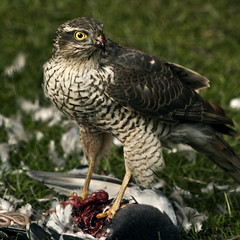 |
| Sparrowhawk in garden |
Q6. Bells can be heard over the live stream. When are the best times to hear them being rung by hand?
 |
| Looking down on the bells of Derby Cathedral. |
But the full peal of bells are best heard when they are rung for about 1 hour before the Sunday services which start at 10.45am and 18.00pm. The bell ringers practice on a Tuesday evening (and sometimes on Friday) from 18.30pm - 23.30pm. Bells are sometimes rung for special services and for some weddings. Visiting teams may ring, too
You may also hear a single bell rung by hand for 5 minutes before Cathedral services held Mon - Fri at 8.30am, 13.05pm; 17.15pm (except Thursday during Term when Evensong is at 6.30pm) The only Saturday service is Evensong at 17.15pm
The Cathedral houses the oldest peal of 10 bells in the world, the oldest dating back to C16th (it was cast in 1520). The tenor bell is the biggest and weighs about 1 ton! When all the bells are ringing the tower actually sways. A giant music box (called a Carillon) plays tunes on the bells every day at 9am, noon and 6pm. Hear them here
Post a comment below if you would like to suggest questions we should provide the answers to.
Children from Holmesfield Infants in Dronfield, near Chesterfield, posted some questions to the blog. They are repeated here with the answers given by the project team.
Hello Oak class: wow - those are some great questions! Here are some answers which may help you:
What do peregrines like to eat? Other birds and quite a wide range of different species too, from quite small ones like finches to birds as big as ducks, magpies and gulls!
How does the mother peregrine hunt if she's incubating the eggs? She doesn't. She leaves all the hunting to the male. He brings back food for her every day. She leaves the eggs to eat it and the male sits on the eggs while she's away. Once she's eaten (and had a quick wash and brush up!) she pushes her mate off the eggs and sits on them herself.
How fast can they fly? Peregrines are the fastest birds on the planet! When they perform their vertical dive called a 'stoop' they have been timed at over 200 miles per hour! That's faster than a formula one car isn't it?
How big are they? Just a bit bigger than a crow - so not very big really. And the female is bigger than the male by about 15%. She's the boss!
Are the eggs smaller than chicken eggs? About the same size as a large chicken's egg.
How do they hunt/catch their food? They have two methods mainly. In open country such as the moors of Derbyshire they will fly very high, watch for a bird flying down below them, close their wings to form a bullet shape and dive vertically down. As they get near the prey they put out their feet and hit it at speed. Sometimes the prey is killed instantly and the peregrine grabs it in mid air OR it falls to the ground and the falcon follows it down.
The other method - and the one we see round about Derby, is for the falcon to fly up behind a flying bird such as a pigeon and simply grab it without the prey seeing it coming. This uses less energy than the first method and is safer for the falcons when there are buildings around them.
Do they hunt food bigger than themselves? Very occasionally they will but usually they choose prey that is smaller than them.
When are the eggs going to hatch? The incubation period is about 30 days....so since the last egg was laid on 11th April, maybe you would like to work out when they will hatch for yourselves?
Will we see the female eat her prey?
The female eats when the male brings food back (he is doing all the hunting at the moment while the female sits on the eggs. He may come back anytime from the early morning to late evening. Depending on the size of the bird he has caught, he may come with food just once a day...or more if the prey was small.
When do the peregrines go to sleep?
Our peregrines sleep (or 'roost') mostly after dark. They turn towards the stones of the cathedral, away from any light (eg from floodlights) and stay motionless with their heads tucked into their feathers.When there are eggs, the female bird will appear to nod off from time to time while she is sitting on them - but she never seems to be completely asleep - she needs to keep an eye open for any intruders that may come to the nest.
sophie from oak class wrote:
"how fast can they fly.
what dose it luck like when they fly.
how do they stoop down to get food.
what colers are on there wings and on there boddey."
love
Sophie.
Our Team says: "Hi Sophie: some good questions there! . . .
. . . Peregrines can fly quite fast in level flight as they fly from A to B and they can turn on the speed if they are chasing after prey. But when they hunt by diving straight downwards from a great height, they can reach speeds of over 200 miles per hour (mph)! That is incredibly fast - faster than small aeroplanes and faster than racing cars in Formula One! This is why they are considered to be the fastest animal on the planet!
When they fly like they have a bullet-shaped body and their powerful wings are pointed at the tips. This is a good shape to help them fly really fast. When they drop down vertically, they close their wings and look rather like a bullet, pointed at the front and back and barrel-shaped in the middle.
When peregrines are adult, they are a lovely bluey-grey on their backs, wings and tail. Underneath they are paler, with bars on their wings and streaks running sideways across their bellies. Their faces are white with a black moustache running down from the base of the beak. Their eyes are dark but are surrounded by a yellow ring. Their feet are also yellow. Younger peregrines that are not yet adult are browner in colour, and you can easily tell them from adults because their belly stripes run up and down, not sideays as in the grown-up birds.
I'm sure your teacher will show you photos of peregrines if you ask her, Sophie!"
______________________________________________________________
Green Class at Brigg Infants School in Derbyshire have also sent comments in about the many observations they have made. Here are a couple, just as we received them:
"We are ecsited that the peregrin has layed four eggs.so we think the birds are doing a very good job of incubating the eggs. The peregrins will keep them nice and warm. Sometimes the peregins role the eggs about to make the chicks grow better."
We said: Hi Green Class: We think the peregrines turn the eggs so that they can keep them at a nice steady temperature and to make sure that the chick inside the egg doesn't stick to the shell as it is growing. Perhaps by watching the webcameras in class you can work out how often the birds need to turn the eggs? Do let us know what you find out.
"We had a gess when we think the first egg is going to be laid. most of the children siad the 29th of march. the elyest was the 23d of march and the latist was the 1st of April. we are makeing a graf to show awer gesses. the least popeler day was the 26 of march because nowone chose it. we hope she dosent lay them in the snow"
Table Test: Please ignore content below - this is a mockup to create a scrolling table with addition year columns.
**table test 2 ends **
** Table test 2 starts ***
| EVENT | 2017 | 2016 | 2015 | 2014 | 2013 | 2012 | 2011 | 2010 | 2009 | 2008 | 2007 | 2006 |
| Mating Observed | - | March | Feb-March | 22 Feb - 30 March | 22 Feb - 30 March | 1 March | 16-24 March | 15 March | 8-16 March | - | - | |
| 1st Egg Laid | 5 April 06:30am | 28 March 13:00 pm | 29 March 14:15pm | 29 March | 4 April | 29 March | 2 April | 24 March | 23 March | 28 March | 3 April | no cams |
2nd Egg Laid | 7 April
13:15pm | 30 March
19:00pm | 31 March 19:30pm | 31 March | 6 April | 31 March | 4 April | - | - | 31 March | - | no cams |
3rd Egg Laid | 9 April 22:30pm | 2 April 08:00am | 3 April 04:20am | 2 April | 9 April | 2 April | 6 April | - | - | 2 April | - | no cams |
| Last Egg Laid | 11 April 08:15am | 4 April 17:00pm | 5 April 13:30pm | 5 April | 11 April | 5 April | 9 April | 31 March | 31 March | 4 April | 9 April | no cams |
| First Egg Hatches | 13 May | 3 May | 5 May | 2 May | 10 May | 5 May | 9 May | 1 May | 29 April | 4 May | 8 May | no cams |
| Ringing Date | no ringing in 2017 | n/a | 24 May | 23 May | 29 May | 25 May | 30 May | no ringing in 2009 | 20 May | 26 May | 1 June | - |
| First Fledging | 16 June | 17 June | 11-22 June | 19-22 June | 14-17 June | 18-22 June | 14-16 June | 9-11 June | 7 July | 23 June | 7 July | |
| No of Eggs Laid/Hatched/Fledged. | 4/3/3 | 4/4/4 | 4/3/3 | 4/4/3 | 4/4/4 | 4/4/4 | 4/4/4 | 4/4/2 | 4/4/4 | 4/4/4 | 4/2/2 | 3?/3/3 1M;2F |
| Chick Ringing
Orange Ring No. (Gender) (Note: orange ring on left leg; silver on right leg) | none ringed | - | 030 (F) 031 (F) 032 (M) | 026 (F?) 027 F?) 028 (M?) | 021 (M) 022 (M) 023 (F) 024 (M) | 016 (M) 018 (M) 019 (F) 020 (M) | 012 (F) 013 (F) 014 (F) 015 (M) | none ringed | 008 (M ) 009 (F) 010 (F) 011 (M) | 003 (F) 004 (M) 005 (M) 007 (M) | 001 (F) 002 (F) | not colour-ringed |
**table test 2 ends **
*** table test 3 starts ***
| EVENT | 2026 | 2025 | 2024 | 2023 | 2022 | 2021 | 2020 | 2019 | 2018 | 2017 | 2016 | 2015 | 2014 | 2013 | 2012 | 2011 | 2010 | 2009 | 2008 | 2007 | 2006 |
|---|---|---|---|---|---|---|---|---|---|---|---|---|---|---|---|---|---|---|---|---|---|
| Mating Observed? | no reports | no reports | no reports | 11th Mar | no reports | no reports | no reports | no reports | 22, 24 Mar | no reports | no reports | no reports | no reports | no reports | 1, 10 Mar | 16, 24 Mar | 15 Mar | 8,15,16, 22 March | 12,13 Mar | 21 Mar | - |
| 1st Egg Laid | no data yet | 10 Mar ?pm | 17 Mar c11pm | 18 Mar 07:30am | 9 Mar | 15 Mar (?) | no breeding in 2020 | 1 Apr 01:00am | 31 Mar | 5 Apr 06:30am | 28 Mar 13:00pm | 29 Mar 14:15pm | 29 Mar | 4 Apr | 29 Mar | 2 Apr | 24 Mar 5am | 23 Mar | 28 Mar | 3 Apr | no cams |
| 2nd Egg Laid | no data yet | 13 Mar | 20 Mar early am | 20 Mar | 12 Mar | 17 Mar | no breeding in 2020 | 4 Apr | 2 Apr 18:20pm | 7 Apr 13:15pm | 30 Mar 19:00pm | 31 Mar 19:30pm | 31 Mar | 6 Apr | 31 Mar | 4 Apr | 26 Mar 2pm | 26 Mar | 31 Mar | ? | no cams |
| 3rd Egg Laid | no data yet | 15 Mar | 23 Mar 4am | c23 Mar? | 14 Mar | 21 Mar | no breeding in 2020 | uncertain | 6 Apr 07:00am | 9 Apr 22:30pm | 2 Apr 08:00am | 3 April 04:20am | 2 April | 9 Apr | 2 Apr | 6 Apr | 28 Mar 11am | 28 Mar | 2 Apr | ? | no cams |
| Last Egg Laid | no data yet | 18 Mar | 25 Mar 7am | 26 Mar | 17 Mar | 24 Mar | no breeding in 2020 | uncertain | 9 Apr 12:30am | 11 Apr 08:15am | 4 Apr 08:15am | 5 Apr 13:30am | 05 Apr | 11 Apr | 5 Apr | 9 Apr | 31 Mar 7am | 31 Mar 3am | 04 Apr | 09 Apr | no cams |
| First Egg Hatches | no data yet | 19 Apr 11pm | 27 Apr | 27 Apr | 18 Apr | 22 Apr 10am | no breeding in 2020 | 13 May | 8 May 12:30pm | 13 May | 3 May | 5 May | 3 May | 10 May | 5 May | 9 May | 1 May | 29 Apr | 4 May | 8 May | no cams |
| Ringing Date | no data yet | 8 May | 14 May | NOT RINGED | 6 May | 18 May | n/a | 10 June | 30 May | no ringing in 2017 | n/a | 24 May | 23 May | 29 May | 25 May | 30 May | no ringing in 2010 | 20 May | 26 May | 1 Jun | not ringed |
| First Fledging | no data yet | 29 May | 4 June (fell!) | 12 June | 27 - 29 May | 4 Jun (?) | no breeding in 2020 | 28 Jun | 16 Jun | ? | 16 Jun | 17 Jun | 11-22 June | 19-22 June | 14-17 June | 18-22 June | 14-16 June | 9-11 June | 11 Jul | 23 Jun | 7 Jul |
| No of Eggs (Laid - Hatched - Fledged) | no data yet | 4 - 2 - 2 | 4 - 3 - 3 | 4 - 1 - 1 | 4 - 3 - 3 | 4 - 3 - 3 | 0 - 0 - 0 | 4 - 2 - 2 | 4 - 3 - 3 | 4 - 3 - 3 | 4 - 4 - 4 | 4 - 3 - 3 | 4 - 4 - 3 | 4 - 4 - 4 | 4 - 4 - 4 | 4 - 4 - 4 | 4 - 4 - 2 | 4 - 4 - 4 | 4 - 4 - 4 | 4 - 2 - 2 | 3? - 3 - 3 |
| Ring 1 | no data yet | Orange XLN (Female) | Orange XRL (Male) | no ringing in 2023 | Orange XJ (Male) | Orange 042 (F) | no breeding in 2020 | Orange 040 (Female) | Orange 033 (Female) | no ringing in 2017 | no ringing in 2016 | Orange 030 (Female) | Orange 026 (Female?) | Orange 021 (Male) | Orange 016 (Male) | Orange 012 (Female) | no ringing in 2010 | Orange 008 (Male) | Orange 003 (Female) | Orange 001 (Female) | Male not ringed |
| Ring 2 | no data yet | Orange XNN (Male) | Orange XSL (Female) | n/a | Orange XK (Female) | Orange 043 (M) | no breeding in 2020 | Orange 041 (Male) | Orange 034 (Female) | no ringing in 2017 | no ringing in 2016 | Orange 031 (Female) | Orange 027 (Female?) | Orange 022 (Male) | Orange 018 (Male) | Orange 013 (Female) | no ringing in 2010 | Orange 009 (Female) | Orange 004 (Male) | Orange 002 (Female) | Female not ringed |
| Ring 3 | no data yet | n/a | Orange XTL (Female) | n/a | Orange XL (Male) | Orange 044 (F) | no breeding in 2020 | n/a | Orange 035 (Male) | no ringing in 2017 | no ringing in 2016 | Orange 032 (Male) | Orange 028 (Male?) | Orange 023 (Female) | Orange 019 (Female) | Orange 014 (Female) | no ringing in 2010 | Orange 010 (Female) | Orange 005 (Male) | n/a | Female not ringed |
| Ring 4 | no data yet | n/a | n/a | n/a | n/a | n/a | no breeding in 2020 | n/a | n/a | no ringing in 2017 | no ringing in 2016 | n/a | n/a | Orange 024 (Male) | Orange 020 (Male) | Orange 015 (Male) | no ringing in 2010 | Orange 011 (Male) | Orange 007 (Male) | n/a | n/a |
| Rescues Required | no data yet | 0 | 0 | 1 (Male) | 2 (XJ & XL) | 1 | no breeding in 2020 | 2 | 1 | 2 | 0 | 1 (031) | 0 | 0 | 0 | 1 (012) | 0 | 0 | 3 (003,005,007) | 0 | 1 |
| Key Events: | New nest box sited on tower roof. | Adult Female dies of Bird Flu. New Female arrives within 2 weeks | New male takes over (with no silver leg ring) New female takes over. Only 1 egg hatches: Male | Pure white egg laid (did not hatch) | No breeding. No internet connection due to Covid. Adult male with silver ring bonds with sub-adult female. Dried up adult male corpse found on roof. | No webcams due to loss of internet connectivity. Same male rescued twice. | 033 (F); 034 (F); 035 (M) Blog discrepancy suggesting male died, but the only male is 035 who paired up in Belper in 2020-2022! | none ringed | none ringed | 030 (F); 031 (F); 032 (M) | 026 (F?); 027 F?); 028 (M?). A young chick dies in nest before ringing | 021 (M); 022 (M); 023 (F); 024 (M) | 016 (M); 018 (M); 019 (F); 020 (M) | 012 (F); 013 (F); 014 (F); 015 (M) | none ringed. 2 chicks die in nest | 008 (M ); 009 (F); 010 (F); 011 (M). 009 later found dead in Derby. Sent for taxidermy. 010 injured and kept by local falconer who called her 'Cathy | 003 (F); 004 (M); 005 (M); 007 (M) | 001 (F); 002 (F) | Nest platform erected on 5th April. None ringed 1M;2F | ||
| Sex ratio Male:Female | no data yet | 1M 1F | 1M 2F | to add | 2M 1F | 1M 2F | n/a | 1M 1F | 1M 2F | to add | to add | 1M 2F | 1M? 2F? | 3M 1F | 3M 1F | 1M 3F | to add | 2M 2F | 3M 2F | 2F | 1M 2F |


10 comments:
Can you tell me please whether there is a particular time of day that the parents feed their young? Added to that I guess that feeding will become more often as the chicks develope.
I would like to see the moment when one of the parents brings in there very own "Big Mac" And finally, which one is the main supplier so to speak?
Peter G
Hi Peter: feeding happens anytime from dawn to dusk - even a bit after that too! And yes, feeding is more frequent when the chicks are bigger.
The male does all the hunting throughout incubation and for at least the first 10-15 days when the chicks are small. He either takes the (plucked) food to the female on the nest or she flies off to collect it from him as he arrives or as he stands on the tower above her. Only when the chicks are bigger and able to keep themselves warm does she start to hunt as well as the male. The male will feed the chicks occasionally - but usually it is the female's job, especially when they are small.
Hope that helps,
Nick
Do the fledglings learn to hunt and feed themselves by instinct alone after they have left the nest or do they follow the parents around and pick it up from them ? I guess sheer hunger alone prompts their need to learn how to do this themselves as quickly as possible once the female stops doing so.
Lorraine Turner.
Another glorious spring / summer day, but how do the chicks manage for water, given that the parents can only bring in "prey", added to that how do they manage to drink water, compared with other "normal" birds.
Peter G
Hi, Just looking at the feed, and noticed one of the chicks seems to be sleeping lying down with it's legs splayed out! Do they always sleep like this, or do they soon start to sleep on their legs like adults?
Hi Julian: good question: answer: I'm not sure. Certainly lying like that is not uncommon before fledging and now I think of it, I've seen then do this on the ledge above the nest post fledging. Whether this is true sleep or just 'resting', even sunning, I'm also not sure.
Will try to be more observant this year!
Nick B (DWT)
Does the sound of loud bell ringing disturb the baby chicks when it goes on for so long?
The mother doesn't seem to cover her chicks at night or in the day when it's cold, also leaves them for long periods, is this normal ,
How far do the adults fly to find food ?Are we likely to see them as far as Mickleover
I have noticed before that the tray gets pretty full of bones towards the end of the season. Does anybody clean it? Or do they scatter them as they move about, or are they just blown away by the wind? I was so pleased to see those four eggs as well.
Post a Comment