Saturday, 25 January 2014

Let courtship begin....and two footnotes!

As we progress towards February and the weather remains mild, we can expect to see our adult birds spending more time on the nest platform.
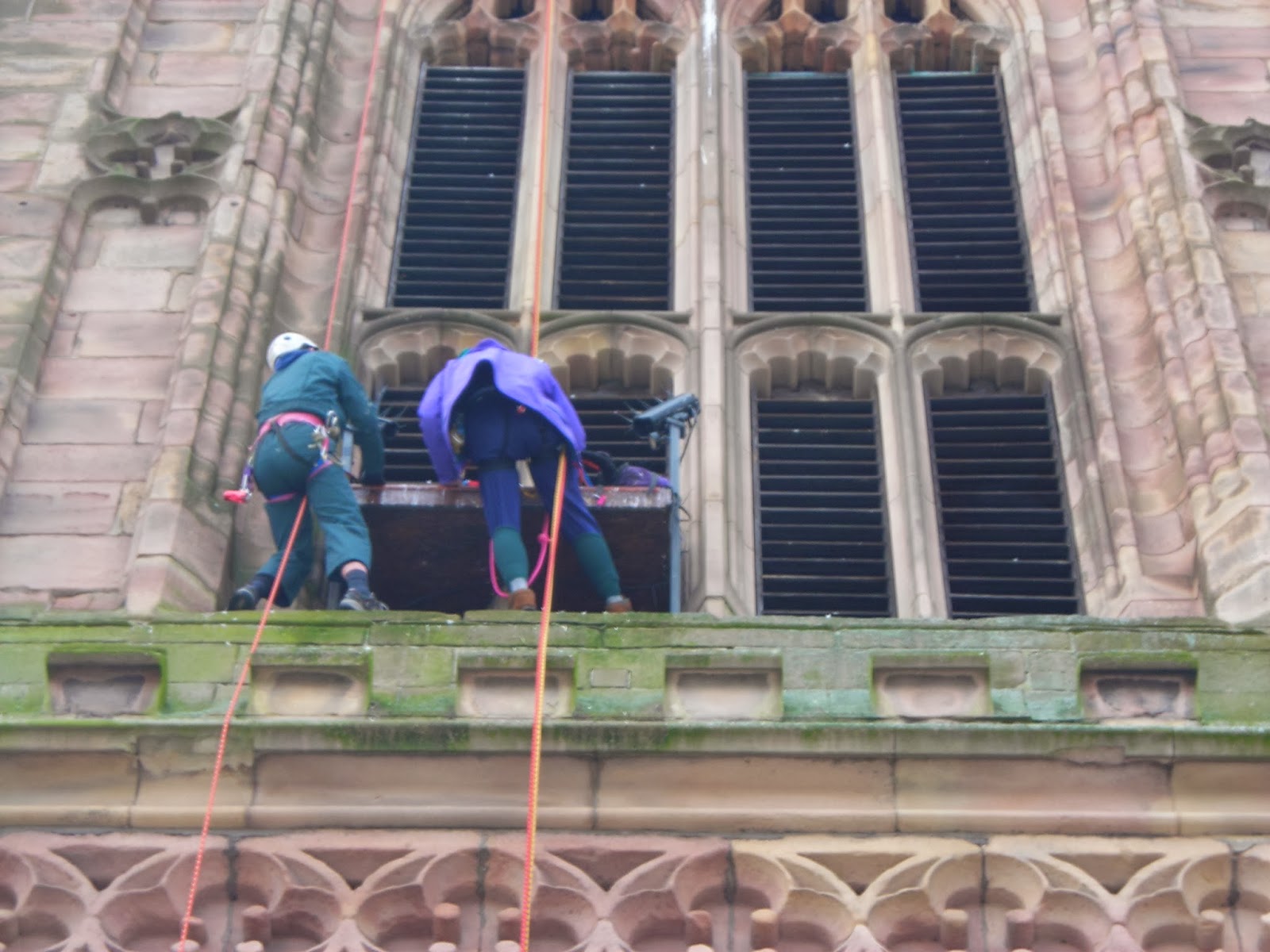
Currently it needs a bit of a 'spring clean' - as do the cameras. So, sometime next month an abseil will be arranged to carry out the necessary annual maintenance work.
January 2012:  preparing to abseil down to clean up the nest 
First, the prey remains will be collected and lowered down to the nave roof for later analysis. Second, the gravel will be refreshed and treated with an anti-bacterial spray. Third, the platform will be thoroughly checked to make sure it is in good shape and that the drainage holes are clear. Fourth, the cameras will be cleaned and re-adjusted. And finally, the abseilers will drop down onto the nave roof below, keen to get inside and warmed up!
Cleaning up the platform 2012

The peregrines take little notice of all this activity and usually return to the tower later the same day. How lucky they are that their nest gets such VIP treatment!
If you have not seen the adults displaying to each other and also scraping out a depression in the gravel then there are several video clips from previous years available on You Tube. Search for VC57UK on YT and all the 50+ video clips should appear together such that you can select the one you want to see.
Job done! So down to the nave roof......

The other way to find the clips (and the blog posts which describe what's going on) is to scroll down this blog looking for the 'SEARCH THIS BLOG' window on the right hand side. Put 'courtship' into that search and several posts will appear, most with the relevant video clip right there, ready to start.

If you see nest scraping or head bowing/courtship displays in the next days and weeks then please do put a comment on the blog so we know what's happening. If it is a really good sequence we may even be able to convert it into yet another YT clip!

Footnote: taking some folk up the top of the tower the other day, we noticed three men on the top of Jurys Inn just above the two falcons. Whether they could see the birds (and visa versa) I'm not clear but they certainly weren't far away were they?
Photo by Abi Ashley
Second footnote: Feb 4th - Not for the faint hearted!
Soon after coming down from the tower this afternoon (and failing to see any peregrines on Jurys Inn to which they normally repair if anyone is on the tower) we photographed this abseiler trying to re-adjust the JI lettering. 
From that position there is a sheer drop of over 200 feet (in old money).
This may explain why our birds had gone temporarily awol! One was back later....so nothing to worry about......
The Jury's out .....of line!
Even this photo doesn't show the whole drop!


Wednesday, 1 January 2014

Writing about peregrines - and painting them


With the nights at their longest just now and not a huge amount happening on the web cams, here are a few reading suggestions (and some art) that might entertain you through these dreary January days.
First, the peregrine 'bible'; The Peregrine Falcon, by Derek Ratcliffe (Poyser) is undoubtedly the most comprehensive and authoritative book on peregrines ever written. Sadly Derek is no longer with us. He would have been delighted by the opportunities provided by modern web cams to examine closely the intimacies of the lives of these iconic raptors!
Published by Poyser and now out of print
Derek Ratcliffe's book is a scientific one, full of facts, tables and details about peregrines and their lives. Incidentally the wonderful artwork is by Donald Watson, a Scottish artist who died a few years ago in his eighties.
For a (much) more readable text, try a book regarded as possibly the best piece of nature writing ever to have been written. J A Baker wrote The Peregrine in the 1960s, having 'set out to track the daily comings and goings of a pair of peregrine falcons across the flat fenlands of Eastern England' (Essex mainly). The book was published in 1967 by Penguin in the UK and by Harpur and Row in The States. Baker, a reclusive man, also died a few years ago.
Cover of the new edition, painting by Elizabeth Frink
A further book to delight in is The Peregrine by Charles Tunnicliffe, also now out of print. It is full of Tunnicliffe's writings, paintings and engravings entirely focused on the peregrines he watched at South Stack on Anglesey over forty years ago.

And here are some more peregrines painted by other wildlife artists that you might enjoy:
This painting is by Mike Warren, a Nottinghamshire based artist
This is by Noel Cusa, a disciple of C F Tunnicliffe.
Note the accompanying sea pinks and navelwort.....

This composite sketch by Darren Woodhead shows a peregrine 
chasing a flock of knot and catching one

This is by Darren Rees. The bird appears to be dozing in the sun
All these artists were (when alive) or still are members of The Society of Wildlife Artists (SWLA). These are artists who really get to know their subjects by studying them in the field where sketches are made before returning to their studios to make finished work. To see more of their work and that of other members go to http://swla.co.uk/ . They hold an annual exhibition in London each autumn - well worth going to. It costs only a few pounds to get in.
Incidentally, more of Charles Tunnicliffe's work can be seen on this website - http://www.thecharlestunnicliffesociety.co.uk/
Nick B (DWT)

Tuesday, 31 December 2013

Some other peregrine sites

Here are six photos of other places where peregrines either nest or have been seen perching over the years .....maybe you can name them?
No. 1 - on the eastern side of the UK

No. 2 peregrines have been recorded here since the 16th century but don't breed
No. 3 Not such a pretty building........and not that far away
 No. 4 The first site with a peregrine web cam in the UK though it didn't last
No. 5 This is very difficult but the town has connections with a certain Iron Lady

No. 6 Peregrines only perch here but they nest nearby


No prizes for guessing the answers but it may amuse you while you are pondering the New Year (and do have a Happy One!). I'll put the answers on here tomorrow evening....if I remember!

Nick B (DWT)

Thursday, 12 December 2013

Pellets

Here's a photo of a peregrine pellet I found recently:

The pellet is about 6 cms. long and 2.5 cms. wide
Peregrines 'cast' pellets through their beaks from time to time to eject both feathers and bone fragments they have swallowed. They are usually fairly dry and grey in colour.
Has anyone ever seen one of our peregrines casting a pellet? (I suspect they don't cast pellets into the nest box but do this activity elsewhere such as above the nest on a ledge.
The bird makes movements which resemble coughing or choking as the pellet is brought up and dispelled.
Only rarely do peregrine pellets contain anything identifiable of interesting. Sometimes if you were very lucky you might find a bird ring inside - but, despite looking many times - I have never done so yet.
(Incidentally, bird pellets don't smell and are usually dry or dryish. Many species - especially those that eat hard objects or use grit/stones to aid digestion - will cast pellets. The species known to cats pellets include robins, rooks, bee eaters, owls and most birds of prey among many others).
You may have heard how owl pellets contain the (often identifiable) bones of the small mammal and other prey they have eaten making them valuable tools in identifying exactly what the owl has been feeding on (see http://www.kidwings.com/teacher/owlpellets/bonechart.htm.)
This is because owls eat the whole prey including the skull and fur/feathers. When the bones (especially the mammal skulls) are extricated from a pellet they can be identified to species making owl pellets a rich source of information. 
By contrast, peregrine prey is usually too big to be swallowed whole so we don't find any skulls, beaks or legs in them.....maybe a bone fragment or two but usually completely unidentifiable broken up feather remains. 
Nick B (DWT)

Friday, 22 November 2013

Up the tower in the sunshine

A quick visit up the tower this afternoon (22nd) in bright sunlight found both adults sitting on the lettering of Jurys Inn. It must be quite a few degrees warmer there than on the east side of the cathedral tower which goes into shade very early in the day in winter. It was also probably more out of the wind too!
South face of Jurys Inn seen from the tower top
with both peregrines just visible as dots on the 'Y' and 'N'
Prey remains were few and far between on this visit. The only thing visible was a headless duck teal on the south side of the tower on top of one of the 'grotesques'. You may just be able to see the speculum on each wing - a small patch of green feathers with white bars above and below them.
View looking vertically down to the pavement and parked cars 200 feet below the tower
The teal is lying on the 'bottom' of the downwards-facing grotesque with its white bars 

on each speculum clearly visible.
This angled view taken by holding the camera out through the bars shows a winged grotesque (the central one of three) in the foreground and the one with the teal beyond. The stonework on this side of the tower is slightly different from that on the east, across which the 'pud' cam looks. The ledge is not so broad as on the east side.
Teal remains just visible on the further grotesque
On the ground below the tower were a few small feathers and one moulted peregrine feather. Peregrine flight and tail feathers are very distinctive as you can see below:

Nick B (DWT)

Friday, 8 November 2013

Fly by night.....and teal and woodcock updates

A quick trip to the top of the tower today (8th November) hoping to find some prey remains looked like being a bit of a wash out (it was raining too by the time I got up there).
There was very little on the roof (someone had been cleaning up I suspect) and also the tops of the 'grotesques' on which the peregrines often sit and leave prey remains were also almost devoid of anything except for the head of a teal - well out of my reach.
However tucked away in the lead spout at the far end of the east side (as seen from the 'pudding' camera that looks across the ledge), there was the corpse of a recently taken wader.
I managed to pull it out and quickly identified it from its size, grey colouring and wing pattern as a knot, a small wading bird.
Left wing of knot showing its wing bar
Knots breed in the arctic but travel south in autumn. British estuaries and bays such as the Wash, Morecambe Bay and the Severn Estuary host thousands of knot (and other arctic waders) during the autumn and winter.
The knot's leg  (tarsus) and foot
This is a common and widespread species occurring in North America as well as Europe and Asia.
In summer the breeding birds turn red underneath which explains their american name - red knot. It's scientific name is Calidris canutus, named after King Canute who famously tried to defy the incoming tide. These waders run along the tide edge and hence the connection.
The link below shows a knot in winter plumage in flight so the wing pattern can be compared:

http://ibc.lynxeds.com/photo/red-knot-calidris-canutus/flight

(More photos and videos of knots can be found at http://ibc.lynxeds.com/species/red-knot-calidris-canutus and on a BBC site at http://www.bbc.co.uk/nature/life/Red_Knot )

The corpse did not smell but wasn't completely fresh so I would guess it was caught the night before last (5th-6th) but obviously I can't be sure. I've not checked to see yet it that ties in with any observations reported to the blog.
Knot are very rarely seen on the ground in Derbyshire and since they migrate at night, I would be confident that this bird flew over Derby after dark perhaps on its way from The Wash to the east to somewhere on the west coast - an easy overnight journey for such a bird. Sadly for the knot, it didn't make it.....
We have recorded knot as prey here at Derby before on eight occasions (this being the ninth) and I recall the species has also been found at Coventry in the West Midlands.
UPDATE 10th November: screenshots taken by Phoebe last night showed a female teal as prey. This small duck is regularly on the menu (except in summer). The photo below shows the green speculum feathers and some of the white bars above and below them:
Pair of wings from a teal found a few years ago at the cathedral
Other prey remains found recently included wood pigeon, woodcock, starling, little grebe, feral pigeon and the knot of course.
Update 12th Nov: a woodcock that had flown into a Derby window and broken its neck was made available to me yesterday. Here are some photos of this beautifully plumaged bird. It is considerably larger than the knot and much heavier too...so more of a meal for a peregrine.
Woodcock - what wonderful plumage!
Unlike knot and other waders, woodcock are entirely nocturnal birds, feeding at night in wet meadows and marshes where they probe for worms with their large straight beaks. Before dawn they fly into woods and settle on the woodland floor, superbly camouflaged among the fallen leaves and the vegetation. Probably something like 100,000 woodcock fly to the UK from Russia, Eastern Europe and Scandinavia to spend the winder with us. Some have been satellite tagged so we know exactly where those birds were breeding.
Many get shot or have accidents while migrating or on arrival here (like this one). A relatively very few are taken by peregrines.
As you can see, woodcock are very dark birds, have no wing bar (unlike the knot) and therefore look quite different when seen on the web cams.
Nick B (DWT)
Ps. The adult male was on the nest ledge when I arrived and the female on Jurys Inn. No sign of a third bird.

Saturday, 26 October 2013

Autumn into winter

With a gale forecast to arrive soon and the clocks going back, autumn is beginning to turn into winter.
It's been surprisingly mild though and late butterflies continue to feed before going into hibernation.
Several commas, red admirals and small tortoiseshells have been in my garden near Derby, feeding on michaelmas daisies and now on ivy blossom. In addition I've put out rotting plums, damsons and bananas which the commas and red admirals love, probing their proboscises deep into the gooey mess.
Red admiral on ivy 
On the bird front, there are still rather few immigrant thrushes in the Derby area. Even though there were some big counts of redwings a few weeks ago, most of them and their larger cousins the fieldfares, must still be in Scandinavia.
Fieldfare by Pauline Greenhalgh 
Meanwhile, those (mostly crazy) bird watchers who indulge in watching visual migration ('vis mig') are getting up at dawn and keeping their eyes on the skies for the next hour or two, when passage, if there is any, is at its height. I myself indulge occasionally. Two mornings ago I counted over 3000 wood pigeons flying south in flocks up to 150 strong. But there were only a handful of thrushes. This morning, pigeons were on the move again, keeping low to the contours as they headed into a blustery SSW wind.
Suddenly, a raptor flew up in front of me and went over my head, rather half-heartedly chasing a pigeon. It was a juvenile male peregrine falcon and I wondered if it might be from the cathedral since I was only a few miles from the city.
Serious vis miggers contribute their sightings to a website run by a Dutchman and called Trektellen. Some counts are amazing either for the sheer number of birds recorded or for the variety of species seen. Look at http://www.trektellen.nl/trektelling.asp?telpost=751 to see how many redwings were counted on a single morning flying over a hill in Bedfordshire on 10th October. That must have been amazing!
The best vis mig watch points tend to be among hills or moors where birds are channelled by the contours. But even if you just step outside your house and look up, wherever you are, on a 'good day' you can expect to see redwings, fieldfares or woodies flying over....as long as you get up early! Usually by 9-10 am, passage is much reduced or over, the birds then settling to feed.
Nick B (DWT)
Ps. The best conditions for movement are good visibility, overcast skies and light SW winds but locally birds may move in a wide range of weather types. On clear nights, go outside anytime after 10/11 pm and listen for the 'seep seep' calls of redwings flying overhead....it's magic to hear them passing....and, as Lorraine commented recently, it must be quite exciting for our cathedral peregrines too.